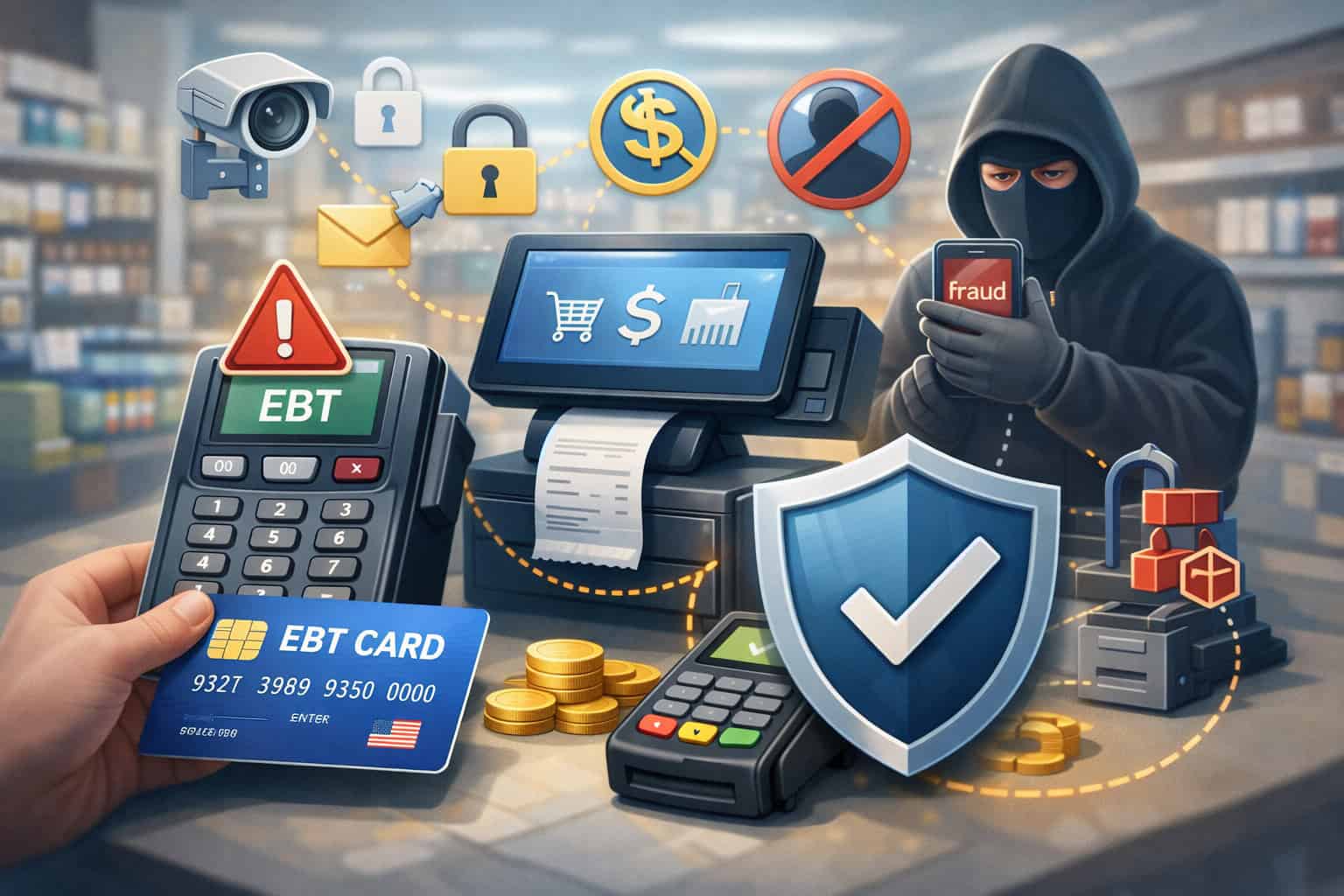
EBT fraud prevention is no longer a “nice-to-have” for retailers that accept benefit cards—it’s a daily operational requirement. Criminals target stores because point-of-sale (POS) lanes, employee workflows, and customer urgency create openings for skimming, PIN theft, refund manipulation, and illegal benefit trafficking.
The good news is that strong EBT fraud prevention doesn’t require turning your checkout into a fortress. It requires a layered plan: secure hardware, disciplined staff routines, smart transaction monitoring, and a clear incident playbook.
This guide explains practical EBT fraud prevention steps you can implement in real stores—c-stores, grocery, small markets, and multi-lane retail—without killing speed or customer experience.
It also covers the compliance stakes, how to document controls, and what’s changing next (including chip-card rollouts in multiple states).
What EBT Fraud Looks Like Today and Why Retailers Are Being Targeted

EBT fraud prevention starts with understanding how fraud is happening right now. The most damaging trend has been benefit theft through card skimming and cloning.
Skimming devices are placed on or inside POS terminals to capture card data and the PIN during a swipe, then criminals duplicate the card and drain the account—often right after benefits load. That timing matters: thieves want maximum balance, and customers discover it only when they try to pay.
Retailers are targeted because checkout lanes are high-traffic, employees rotate, and terminals are handled constantly—perfect conditions for tampering. Some fraud is external (skimmers, shoulder-surfing, fake “technician” visits).
Other fraud is internal or collusive, such as refund abuse or trafficking schemes designed to look like legitimate sales. That’s why EBT fraud prevention must cover both “terminal security” and “transaction integrity.”
Losses are not just financial. They create angry customers, chargeback-like disputes, investigations, and reputational damage. Federal oversight of retailer compliance and trafficking enforcement is real, and enforcement can include severe sanctions up to permanent disqualification.
When you treat EBT fraud prevention as a system—people, process, and technology—you reduce losses, protect customers, and build an audit-ready operation.
The Compliance and Enforcement Stakes: What Your Store Risks If Fraud Happens

EBT fraud prevention is also compliance management. If your store is authorized to accept SNAP benefits, you are expected to follow program rules, prevent trafficking, and maintain operational controls that reduce violations.
Regulators don’t require perfection, but they do look for patterns and whether you had an effective compliance policy and program in place.
A key legal point: regulations allow for a civil money penalty (CMP) in some trafficking-related cases instead of permanent disqualification if a firm can show it has an effective compliance policy and program and meets the criteria—timelines and documentation matter.
This is a major reason EBT fraud prevention should include written procedures, training logs, and proof of enforcement.
Enforcement actions often rely on transaction patterns, comparative analysis, and investigative findings, not just “caught on camera” evidence. Final agency decisions show that questionable transaction data can be enough to support severe penalties when trafficking is considered the most probable explanation.
So EBT fraud prevention isn’t only about stopping skimmers; it’s about preventing suspicious sales patterns that can be interpreted as trafficking.
Your best defense is proactive: train staff, enforce “eligible items only,” avoid “workarounds,” document management oversight, and monitor anomalies. EBT fraud prevention should be treated like any other high-risk payment acceptance program, with controls that are consistent and provable.
Skimming and Cloning: The #1 Threat to Customers and a Major Risk to Your Store

EBT fraud prevention must prioritize skimming because it’s one of the most common and scalable attacks. Skimming occurs when criminals attach an overlay or insert a device into a payment terminal used during swipes.
The device captures the EBT card number and magnetic stripe data, and criminals combine that with the stolen PIN to clone the card and steal benefits.
The reason it persists is simple: magnetic stripes are easy to copy. That’s why multiple states are moving toward SNAP EBT chip cards (EMV) alongside the traditional stripe.
Chip cards are designed to make counterfeit fraud far harder because the chip creates unique cryptographic data, unlike static stripe data. Retailers should prepare for mixed environments where customers may present chip cards, stripe cards, or both—depending on the state and timeline.
Practical EBT fraud prevention for skimming includes: daily terminal inspections, tamper-evident seals, locked-down cable routing, and strict rules around who can touch devices. The best stores treat POS lanes like cash drawers—never “public property.”
Also, don’t ignore “soft” skimming threats: fake QR codes near checkout, phishing texts that trick customers into revealing PINs, and shoulder-surfing when customers enter PINs.
When skimming hits your store, customers often blame you—even if you’re also a victim. Strong EBT fraud prevention protects the customer, protects your brand, and reduces the chance that your store becomes a repeat target.
Benefit Trafficking and Transaction Manipulation: The Fraud That Can Get You Disqualified
EBT fraud prevention must also address trafficking—the illegal exchange of benefits for cash or other ineligible value. Trafficking is different from skimming: it usually involves misuse at the transaction level, and it can be external, internal, or collusive.
Federal retailer notices emphasize the importance of reporting suspicious activity and using retailer training materials that explain rules and requirements.
Common trafficking patterns include: unusually high basket totals at a small-format store, repetitive identical dollar amounts, rapid multiple transactions on the same card, or purchases that don’t match your inventory (for example, large “grocery” totals when your shelves are mostly non-eligible items).
Other manipulation includes “phantom returns,” where an EBT sale is reversed for cash-like value, or where refunds are processed to a different tender type.
This is where EBT fraud prevention intersects with point-of-sale configuration. Your POS should enforce eligible-item logic, prevent manual overrides that convert ineligible items, and restrict refund methods.
Your policy should also be clear: employees must never offer cash back, never “split” tenders in ways that mimic cash exchange, and never process refunds without receipt and manager approval.
Because enforcement can rely on transaction analytics, EBT fraud prevention should include your own analytics: monitor top EBT cashiers, top EBT tickets, high-velocity cards, and refund ratios.
A store that can show active monitoring and corrective action is in a much stronger position than a store that only reacts after a letter arrives.
Building an EBT Fraud Prevention Program That Actually Works in a Busy Store
EBT fraud prevention succeeds when it’s operationally realistic. Your program should be a repeatable cycle: risk assessment → controls → training → monitoring → incident response → improvement. If you skip the “monitoring” step, you won’t catch drift. If you skip “improvement,” criminals will adapt faster than you do.
Start with a simple risk assessment tailored to your store:
- How many terminals do you have, and are any customer-facing/self-checkout?
- How often do terminals get moved, rebooted, or serviced?
- What’s your staff turnover?
- Do you sell high-risk items (gift cards, high-value packaged goods) that create refund pressure?
- Are EBT transactions concentrated in certain hours or lanes?
Then define controls in three layers:
- Physical POS protection (anti-tamper, inspections, service verification)
- System rules (POS settings, permissions, refund restrictions, alerts)
- People controls (training, manager approvals, job aids, coaching)
EBT fraud prevention should also include documentation: a one-page inspection checklist, a training script, and an escalation flow. You want something a manager can run even on a chaotic Friday night.
Finally, assign ownership. If everyone owns EBT fraud prevention, no one owns it. Designate a “POS security lead” and a “compliance lead” (they can be the same person in small stores). Make it measurable: inspection completion rate, training completion rate, exception review cadence, and incident response speed.
POS and Payment Security Controls That Reduce EBT Fraud Immediately
EBT fraud prevention gets dramatically stronger when POS controls are hardened. The goal is to make tampering difficult, visible, and risky for criminals—while also limiting internal misuse.
Key controls to implement:
- Terminal mounting and cable control: Terminals should be anchored or secured, with cables routed so attachments are obvious.
- Tamper-evident seals: Apply unique-number seals to access points and train staff to check them.
- Daily inspection routine: Quick checks at open, mid-shift, and close for overlays, loose parts, unusual resistance in card slots, or new devices.
- Service verification protocol: Only approved vendors can service terminals; require ID, a work order, and manager escort. No exceptions.
- User permissions: Cashiers should not have admin permissions to override eligibility rules or process unusual refunds.
- Software updates and device inventory: Keep a current list of terminals and ensure updates are applied; unknown devices are a red flag.
State and federal agencies have signaled increased focus on skimming prevention and retailer messaging. Meanwhile, chip-card initiatives are moving forward in multiple states to reduce counterfeit and cloning risk, which means retailers should ensure terminals can support chip acceptance when EBT chip cards are issued.
If you want the simplest “high impact” move: implement inspections + seals + strict service verification. Those three steps alone improve EBT fraud prevention fast because they attack the easiest path criminals use—quiet physical access.
Employee Training and Frontline Scripts: The Human Layer of EBT Fraud Prevention
EBT fraud prevention fails when employees don’t know what “normal” looks like. Your training must be short, specific, and repeated. Think “micro-training” in 10-minute blocks, not a single annual lecture.
Teach employees to recognize:
- Terminal tampering signs: overlays, wobbling terminals, broken seals, new cables, suspicious “adapter” blocks.
- Behavioral red flags: someone lingering near terminals, trying multiple cards quickly, distracting staff, or claiming to be a technician.
- Transaction red flags: repeated identical amounts, rapid back-to-back EBT transactions, unusual refunds, or customers pressuring for “cash-like” exchanges.
Give employees scripts they can use without conflict:
- “I’m not able to process that request, but my manager can explain the policy.”
- “For your security, please cover the keypad while entering your PIN.”
- “This terminal is temporarily unavailable—please use lane 2.” (If tampering suspected)
Managers should reinforce a culture where reporting is praised, not punished. Employees often hesitate because they fear being wrong. EBT fraud prevention improves when you reward “good catches,” even when they turn out to be false alarms.
Also train employees on trafficking rules and the importance of program integrity. Retailer training materials and notices emphasize rules, requirements, and reporting suspicious activity—your staff should know where the “Report Abuse” poster is and what to do if something feels off.
Customer-Facing Protection: Helping Shoppers Without Slowing Checkout
EBT fraud prevention works best when customers are part of the defense. Many benefit theft incidents involve PIN compromise or card cloning after a swipe. The customer can’t inspect your terminal internals, but they can protect their PIN, spot suspicious signage, and act fast when something looks wrong.
Add clear, calm messaging near PIN pads:
- Cover the keypad while entering PIN.
- Report a loose or unusual terminal immediately.
- If your state supports it, use account controls (like locking/unlocking the card or restricting out-of-area use) and change the PIN regularly.
Some states and EBT service platforms offer features that act like a “freeze” on a card or limit transactions. Even if those tools are managed by the cardholder, you can still promote them with a simple handout or small sign. That’s real EBT fraud prevention because reducing successful theft reduces angry incidents at your store.
Also, train cashiers to proactively protect customers without sounding accusatory:
- “For your security, please shield the keypad.”
- “If your card declines unexpectedly, you may want to check your balance before trying again.”
Finally, be thoughtful about self-checkout. If you offer it, EBT fraud prevention should include extra inspections because self-checkouts are attractive targets: less supervision, predictable traffic, and frequent swipes.
This customer-facing layer is also reputational insurance. When customers see visible EBT fraud prevention behaviors, they trust your store more—and criminals see you as a harder target.
Monitoring and Analytics: Catching Fraud Patterns Before They Become Investigations
EBT fraud prevention isn’t complete without monitoring. The same way you watch voids and cash over/short, you should review EBT exceptions. The goal is not to accuse customers—it’s to detect patterns that indicate terminal compromise, employee misuse, or trafficking risk.
Set up weekly (or even daily) reviews of:
- High EBT ticket averages compared to your typical basket size
- Repeated identical transaction amounts
- Multiple transactions on the same card in short windows
- High refund rates tied to EBT sales
- EBT activity by cashier (outliers deserve coaching)
- After-hours or unusual-hour spikes
If you’re part of a chain, compare store-to-store. If one location has double the EBT average ticket, that’s a signal to inspect inventory alignment and cashier behavior. If you’re a single store, compare by daypart and by lane.
This is also where you protect yourself from skimming incidents. A skimming compromise can create a pattern: increased EBT declines, customer complaints about drained balances shortly after shopping, or an unusual number of balance inquiries. Treat these as EBT fraud prevention triggers—inspect terminals immediately and escalate.
Government oversight bodies have emphasized measurement and oversight issues related to trafficking estimates and program integrity, which reinforces why retailers should take monitoring seriously rather than treating it as optional.
Document your reviews. A simple log showing you check exceptions and take action is powerful EBT fraud prevention evidence.
Incident Response: What to Do If You Suspect Skimming, Cloning, or Trafficking
EBT fraud prevention includes a “when it happens” plan, not just “how to stop it.” The first hour matters. If an employee suspects tampering, your response should be fast and consistent:
- Take the terminal out of service immediately (without tipping off a suspect if safety is a concern).
- Preserve evidence: don’t open or dismantle the device; photograph it in place.
- Notify management and security and document time, lane, employee names, and observations.
- Contact your POS/vendor support for guidance and to check device logs and serial numbers.
- Report through appropriate channels if required, especially when suspicious activity indicates program abuse or device compromise.
Federal retailer materials emphasize reporting suspicious activity and provide official points of contact and guidance pathways for retailer concerns.
If the incident involves suspected trafficking or internal collusion, treat it like any other serious compliance event:
- Pull transaction logs
- Suspend access for involved user IDs pending review
- Review camera footage where available
- Document corrective actions and retraining
Communications matter. Train staff not to blame customers or speculate. Use neutral language: “We’re investigating a potential terminal security issue.” Offer practical next steps: check balance, contact the EBT customer service number on the back of the card, and consider changing PIN.
A clear incident plan is EBT fraud prevention in action because it reduces repeat victimization and shows you operate responsibly.
Future of EBT Fraud Prevention: Chip Cards, Smarter Controls, and What Retailers Should Prepare For
EBT fraud prevention is evolving because criminals adapt. The most important shift is the move toward SNAP EBT chip cards (EMV) in multiple states, specifically to reduce counterfeit card fraud and benefit theft.
Retailers should expect a transition period where both mag-stripe and chip transactions exist, and where staff must know how to handle “dip vs swipe” correctly.
Here’s what to prepare for over the next few years:
- Broader chip adoption: More states are expected to follow early chip issuers, increasing the need for chip-capable terminals and correct configuration.
- Better device-level security standards: Processors and vendors will push stronger tamper detection and remote monitoring.
- More real-time fraud analytics: Expect more alerts tied to transaction velocity, location anomalies, and suspicious patterns.
- Customer-controlled security tools: Card lock/unlock and transaction restrictions will become more common, and retailers who educate customers will see fewer incidents at checkout.
But don’t assume the chip solves everything. Fraud may shift toward phishing, social engineering, account takeover, and “card-not-present” style exploitation of benefits systems where applicable. That means EBT fraud prevention will still require staff training, strong store procedures, and monitoring.
FAQs
Q.1: What are the most common EBT scams that hit retail stores?
Answer: The most common EBT scams fall into two buckets: terminal compromise and transaction abuse. Terminal compromise includes skimming devices and tampering that capture magnetic stripe data and PINs, enabling cloned cards and benefit theft.
Transaction abuse includes trafficking, fake returns, refund manipulation, or cashier collusion designed to convert benefits into cash-like value.
EBT fraud prevention should address both because focusing on only one leaves a gap. A store can have perfect terminal inspection but still face trafficking risk if staff bypass item eligibility or process suspicious patterns.
Likewise, strict anti-trafficking rules won’t help if criminals are physically installing skimmers on unattended lanes.
Current policy discussions and guidance emphasize skimming and benefit theft as a major issue, which is why chip-card transitions and retailer-focused prevention messaging are gaining attention.
Q.2: How often should we inspect EBT terminals for tampering?
Answer: For strong EBT fraud prevention, inspect terminals at least daily, and ideally multiple times per day in high-traffic stores. A practical cadence is: opening, mid-shift, and closing. Add an inspection anytime a terminal is moved, reset, “acts weird,” or after an unusual surge in EBT complaints.
Inspections don’t need to be slow. Train staff to check for: loose card slots, new overlays, broken seals, unfamiliar cables, or anything that looks “added on.” Use tamper-evident seals with unique IDs to make it obvious when a device has been opened.
Because skimming devices can be installed quickly, the value of inspections is frequency. High-frequency inspections reduce the time window criminals have to capture data—an immediate EBT fraud prevention win. And when combined with strict “authorized technician only” rules, you dramatically reduce successful compromise.
Q.3: Can a store be penalized even if it was a victim of skimming?
Answer: Skimming victimization and trafficking enforcement are different issues. If your store was victimized by skimming, you may not be “at fault,” but you can still face operational consequences: customer disputes, reputational harm, and scrutiny if patterns suggest weak controls.
That’s why EBT fraud prevention should include documented inspections, vendor access controls, and incident response.
For trafficking-related enforcement, penalties can be severe, including disqualification, and regulations describe circumstances where a CMP may be considered if the firm can demonstrate an effective compliance policy and program with supporting evidence and timelines.
Q.4: What POS settings help most with EBT fraud prevention?
Answer: The highest-impact POS settings for EBT fraud prevention are the ones that eliminate “easy abuse”:
- Enforce eligible-item rules and block manual overrides.
- Restrict refund methods so EBT refunds return to the original tender where required.
- Require manager approval for voids, returns, and price overrides tied to EBT baskets.
- Limit who can access admin functions (unique logins, no shared credentials).
- Enable exception reporting (high ticket, repeat cards, rapid repeats, refund spikes).
These controls work because they reduce both internal and collusive fraud. They also create cleaner records if you ever need to explain transactions. Combine POS configuration with monitoring, and your EBT fraud prevention becomes proactive: the system prevents risky actions before they happen.
Q.5: How do we train staff without making customers feel judged?
Answer: EBT fraud prevention training should focus on security behaviors, not customer identity. Teach employees to say “for your security” rather than “because fraud happens.” Use universal practices: cover keypad, don’t allow unknown technicians, manager approval for refunds, and immediate escalation of suspicious terminal changes.
Make it routine. When every customer hears the same calm reminders, it doesn’t feel targeted. Also, train staff to handle conflicts: if a customer is upset about a decline, the cashier should offer practical steps (check balance, change PIN, contact the number on the card) rather than speculating about fraud.
This approach supports EBT fraud prevention while preserving dignity and speed. It also reduces confrontation, which improves employee compliance—people follow policies more consistently when the scripts are easy and respectful.
Q.6: Will chip cards eliminate EBT fraud?
Answer: Chip cards will significantly reduce counterfeit and cloning based on magnetic stripe data, which is a major driver of benefit theft. That’s why states are moving toward SNAP EBT chip cards and retailers are being advised to prepare for chip acceptance and operational updates.
But chip cards won’t eliminate all fraud. Criminals adapt. Expect more emphasis on phishing, social engineering, and account compromise attempts. That’s why EBT fraud prevention must remain layered: terminal security, staff discipline, POS controls, customer education, and monitoring.
Think of chip cards as a major upgrade—not the finish line. The retailers who keep improving EBT fraud prevention will stay ahead of shifting tactics.
Conclusion
EBT fraud prevention is most effective when it’s consistent and boring—in the best way. The stores that win don’t rely on luck or one-time training. They run simple routines every day: inspect terminals, control who touches devices, configure POS rules to prevent abuse, train staff with short scripts, and review exceptions on a schedule.
To recap the most important EBT fraud prevention moves:
- Treat POS terminals like high-risk assets: seals, inspections, and controlled servicing.
- Lock down refunds and overrides to reduce trafficking and manipulation risk.
- Train employees to spot tampering and follow an escalation plan without hesitation.
- Educate customers with respectful reminders and visible security cues.
- Monitor transaction patterns so you catch issues early—before they become investigations.
- Prepare for the next wave: chip-card adoption and stronger fraud analytics.
If you implement these layers, you don’t just reduce losses—you reduce stress, customer friction, and compliance risk. Strong EBT fraud prevention protects your shoppers, your staff, and your ability to keep serving the community confidently.