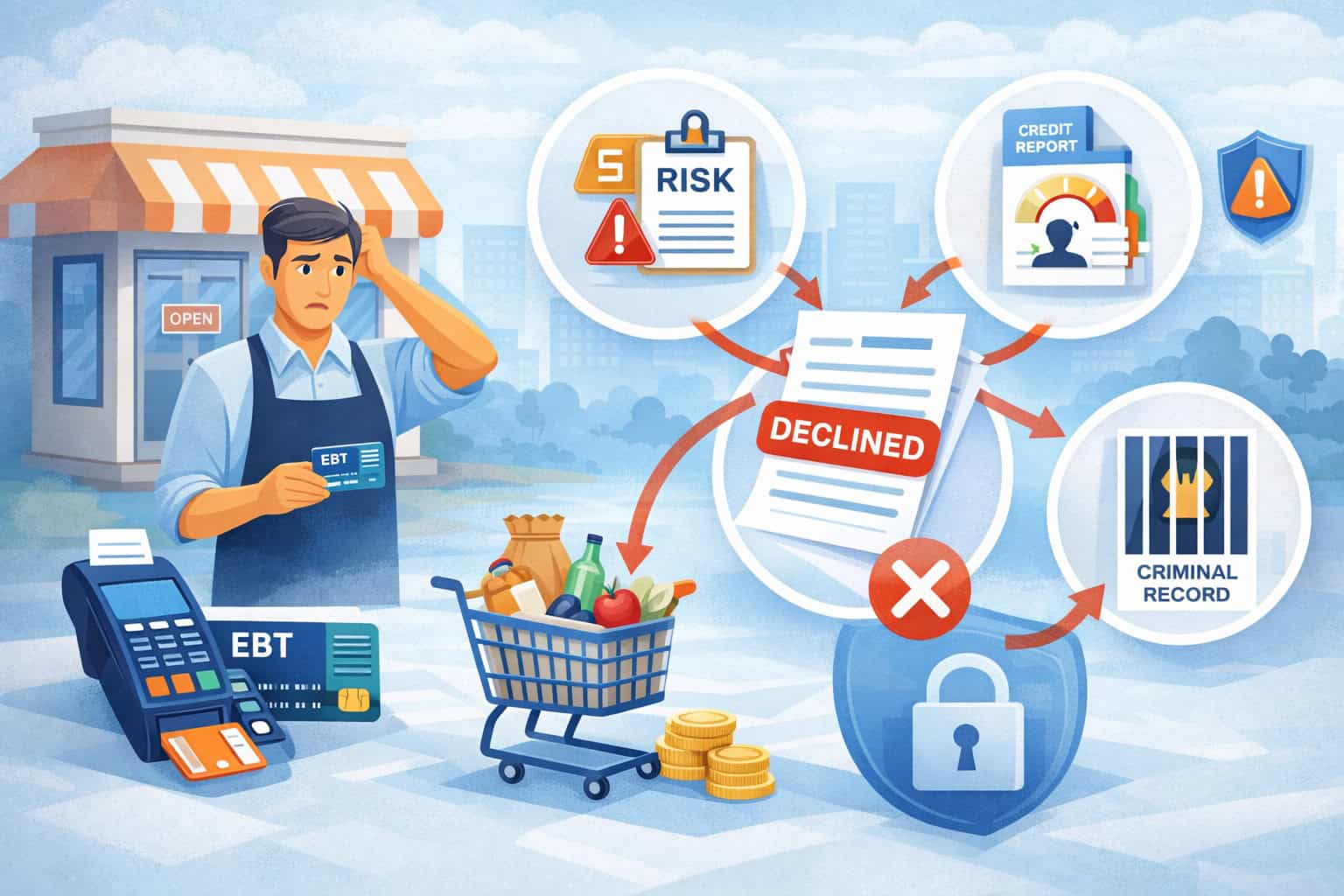
If you’re trying to add EBT acceptance (often tied to SNAP and, in some cases, cash-benefit programs) to your checkout, the most frustrating outcome is getting an “EBT merchant account rejection” notice from a processor or getting stalled after approval because your setup can’t be certified.
The good news: most rejections are predictable—and preventable—when you understand what underwriters and program rules are actually looking for.
This guide explains how to avoid EBT merchant account rejection by aligning (1) your business eligibility, (2) your documentation, (3) your store operations, and (4) your payment technology with what EBT programs and processors require.
It’s written for retailers, markets, specialty food sellers, and ecommerce operators who want a clear path to approval and long-term compliance—without bloated paragraphs or confusing legal language.
Throughout this article, you’ll see the key phrase avoid EBT merchant account rejection used naturally and repeatedly, because that’s exactly what you’re here to do.
What “EBT Merchant Account Rejection” Really Means (And Who Can Reject You)
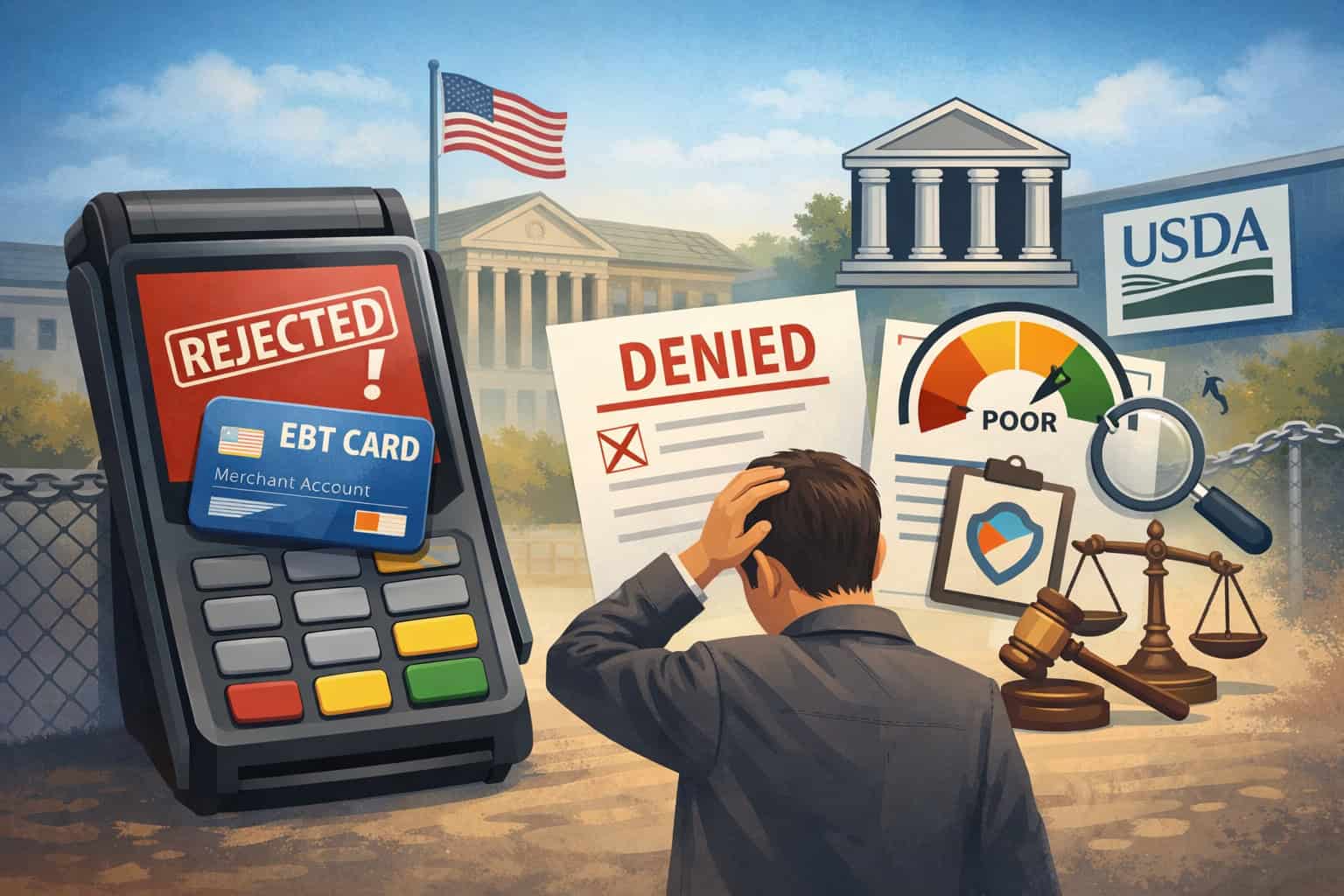
An EBT merchant account rejection can happen at two different layers, and knowing which one applies will help you fix the right problem fast.
Layer 1: Program authorization
For food benefits, authorization is handled through the program administrator (commonly USDA Food and Nutrition Service for SNAP retailers). If you are not authorized (or your authorization is pending/expired), you may be blocked from processing EBT even if you have a card-processing account.
Program rules focus on the types of items you sell, how you operate, and whether your store meets eligibility tests and ongoing compliance expectations. Training materials and enforcement notices emphasize that retailers must follow program rules and that violations like trafficking can lead to serious penalties.
Layer 2: Payments/processor underwriting
Even if you’re authorized, a processor (or a third-party EBT processor) can still decline you based on risk, documentation gaps, technology limitations, or compliance concerns.
Underwriting teams look for mismatches: your website says one thing, your application says another, and your inventory or transaction patterns suggest something else. That’s often where people get stuck and wonder why they were denied even though they “sell food.”
To avoid EBT merchant account rejection, you need to clear both layers. Think of it like a two-key system: authorization unlocks eligibility, and underwriting unlocks the payment rails and equipment configuration you need to actually run transactions.
Eligibility Foundations: The Fastest Way to Avoid EBT Merchant Account Rejection
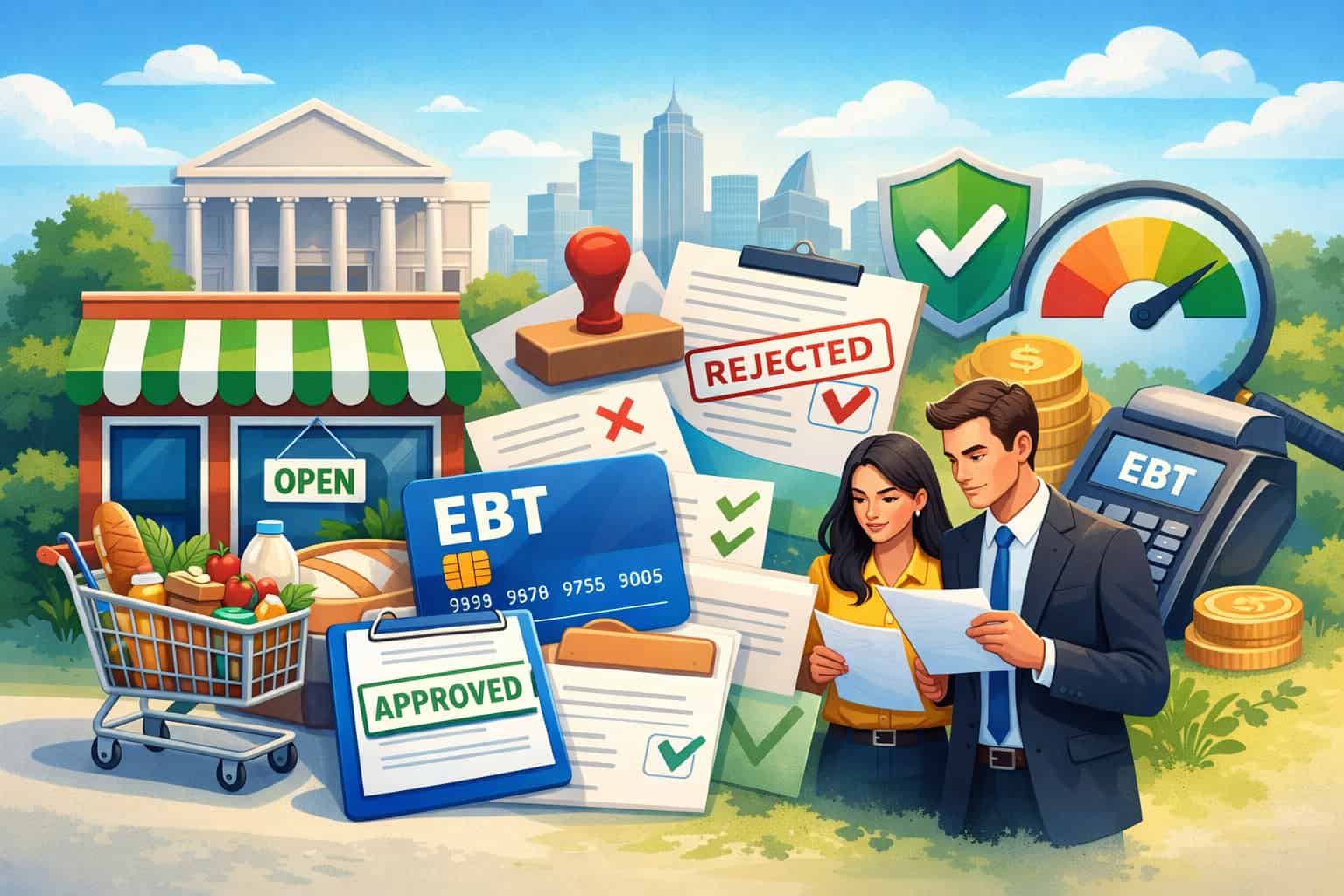
The most common cause of EBT merchant account rejection is simple: the business doesn’t clearly meet eligibility expectations for EBT food benefits, or it can’t prove it. That doesn’t always mean you’re ineligible—it often means your application doesn’t communicate eligibility in a way underwriters can verify.
Start with your inventory reality. If you’re a retailer seeking food-benefit EBT acceptance, your store must be a legitimate food retailer in both product mix and day-to-day operations. Many rejections occur when the inventory appears too limited, too seasonal, or too inconsistent to demonstrate true grocery-style availability.
For example, a shop that mostly sells prepared foods, supplements, novelty items, or non-food merchandise can trigger concern if the “staple food” presence isn’t obvious in documentation and on-site evidence.
Next, confirm your store format and operational readiness. Retail authorization processes typically don’t require you to already have EBT equipment before you apply, but once authorized, you’re expected to arrange equipment and services promptly so you can participate properly.
That’s why it’s smart to plan your equipment and processor path early—before you submit final underwriting paperwork.
Finally, consider your business model. If you’re online-only, marketplace-based, or delivery-first, you may face additional requirements (like approved online PIN-entry solutions through recognized third parties).
Industry references about online EBT emphasize the role of secure PIN entry solutions used by third-party processors in ecommerce flows.
If you want to avoid EBT merchant account rejection, treat eligibility like a “case file”: make it easy for a reviewer to quickly say, “Yes—this merchant sells qualifying items, operates legitimately, and can comply.”
Documentation Underwriting Checklist: Build a “No-Questions” Application Package

Underwriters don’t reject great businesses—they reject unclear ones. To avoid EBT merchant account rejection, submit a package that answers the reviewer’s questions before they ask them.
A strong EBT application package usually includes:
Business identity proof
- Formation documents (or equivalent proof you’re a legitimate entity)
- Business license (if required in your locality)
- EIN letter or tax registration proof (if applicable)
- Ownership IDs for beneficial owners and signers
Location and operational proof
- Lease, utility bill, or other proof of location
- Photos of storefront signage (if brick-and-mortar)
- Photos of shelves/freezers/refrigeration and checkout area (this helps a lot)
Inventory and product proof
- Invoices from suppliers showing qualifying food items
- A short inventory list focused on staples and eligible categories
- For markets: vendor roster + examples of produce/meat/dairy/bread availability
Banking and settlement proof
- Voided check/bank letter
- Recent bank statement (to confirm settlement account ownership)
Digital presence consistency
- Website (or social pages) must match the business description
- Clear refund/return policy, contact info, address, and what you sell
- If delivery: transparent delivery areas and fulfillment model
Processors and EBT-related guidance commonly advise retailers to evaluate third-party processing deals and contracts carefully, but the hidden advantage is this: a reputable provider will tell you exactly which documents are missing so you can correct them quickly.
When your documents align, you dramatically reduce the chances of EBT merchant account rejection due to “incomplete file” or “unable to verify.”
The “Mismatch Problem”: How Inconsistent Business Details Trigger EBT Merchant Account Rejection
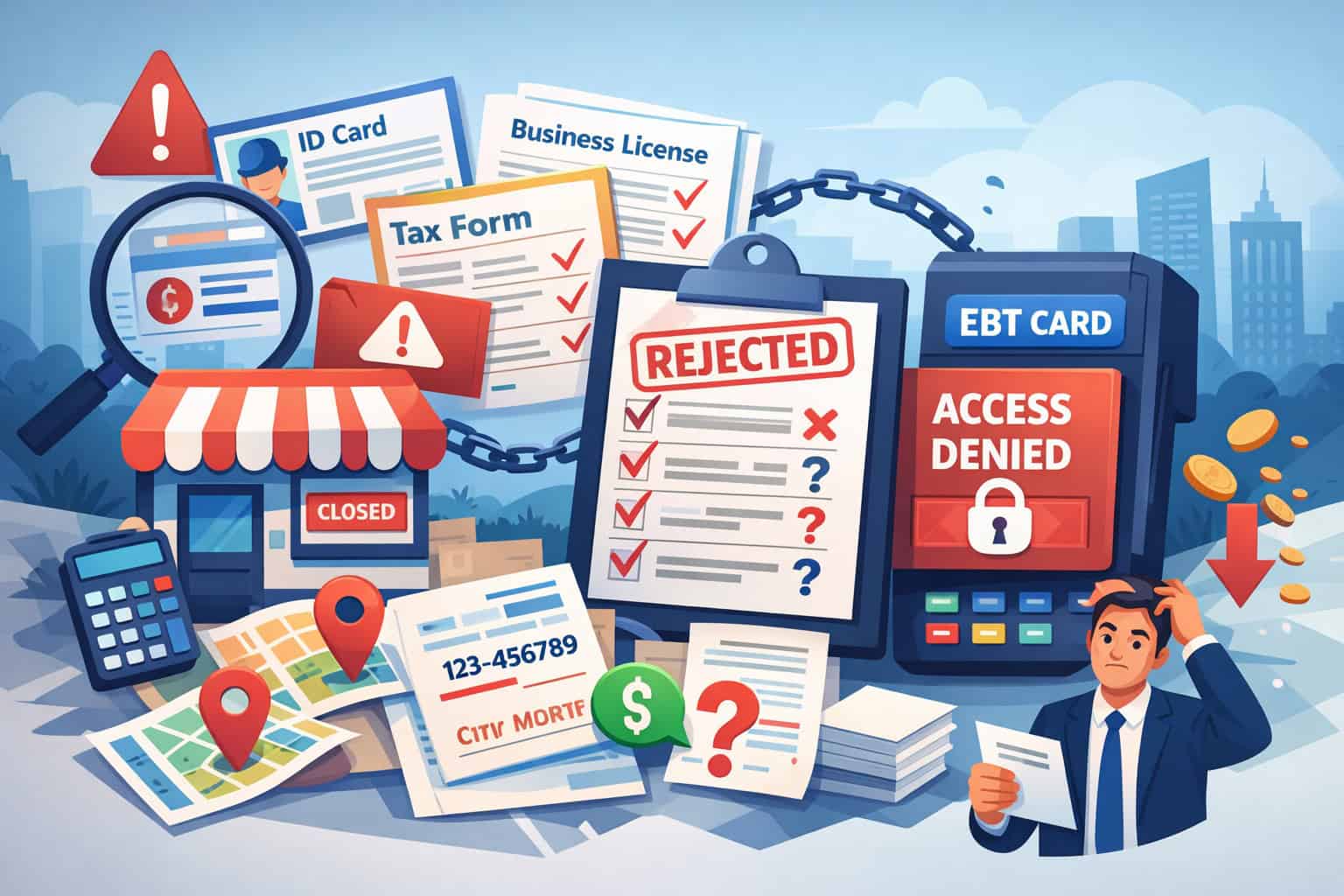
A huge percentage of EBT merchant account rejection cases come from mismatches across four places:
- your application, 2) your bank records, 3) your public presence, and 4) your actual operations.
Here’s how it happens in real life:
- Your legal business name differs from your storefront name, and the DBA isn’t documented.
- Your website sells items that look ineligible or high-risk for the program you’re applying for.
- Your product mix online looks different from what you claim in the application.
- Your MCC or business category doesn’t fit what you say you do.
- Your address is a mailbox/virtual office, but you describe a retail store.
Underwriters treat inconsistencies as risk signals. Even if everything is legitimate, a mismatch forces manual review, and manual review increases rejection probability.
To avoid EBT merchant account rejection, do a “consistency audit” before you apply:
- Make sure the business name/DBA appears the same on bank account, application, signage, and website.
- Make sure your website product categories and photos match your described inventory.
- Make sure your support email/phone/address are real and monitored.
- Make sure your refund policy is easy to find and realistic.
If you sell both eligible and ineligible items, don’t hide it—explain how your POS separates eligible EBT items from non-EBT items at checkout. That kind of proactive clarity often flips an underwriter from “uncertain” to “approvable.”
Inventory, Receipts, and Store Layout: Proving You’re an Eligible Food Retailer
When you’re trying to avoid EBT merchant account rejection, your inventory proof matters as much as your paperwork. Many merchants assume, “I sell food, so I qualify.” Underwriters and program reviewers think, “Show me.”
The simplest way to prove readiness is to document three things:
1) Breadth of staple inventory: A few snack items rarely persuade reviewers. You want invoices and shelf photos showing staple-type food presence: produce, dairy, meat/poultry/fish, grains/bread, and similar categories depending on your store model.
2) Ongoing stocking pattern: One-time invoices can look staged. If possible, provide multiple supplier invoices over time. If you’re new, provide supplier agreements plus opening inventory purchase orders.
3) Checkout reality: Your checkout must support correct tendering: EBT should only apply to eligible items, while other tender types cover non-eligible products. This matters because enforcement actions focus heavily on misuse and suspicious patterns, especially anything resembling trafficking.
Store layout also influences credibility. A store with visible grocery shelving, refrigeration, and clearly priced items looks like a retailer. A store with minimal food and lots of unrelated merchandise can look like an EBT risk.
If you operate a farmers market or multi-vendor setting, show operational structure: how vendors are approved, what products are sold, how receipts work, and how EBT transactions are processed and tracked.
This is a core method to avoid EBT merchant account rejection: make your eligibility visible, not assumed.
Compliance Triggers Underwriters Watch: Trafficking Risk, Refund Abuse, and Transaction Patterns
If you want to avoid EBT merchant account rejection, you must understand the risk patterns underwriters and program compliance teams watch for. The biggest red flag category is trafficking risk—the illegal exchange of benefits for cash or non-eligible items.
Retailer training and enforcement communications emphasize posting anti-abuse notices and reporting suspicious activity, underscoring how seriously compliance is treated.
Even before you process your first EBT transaction, underwriters may assess whether your business model could easily enable abuse. They look at:
High-risk product mixes
- Stores with limited eligible food but many non-food items
- Businesses that sell high-dollar non-eligible items
- Operations where “cash-like” value could be exchanged
Refund and dispute behavior
- Unclear return policies
- Ability to refund in cash for purchases made with benefits (a compliance risk)
- Lack of controls around voids and returns
Projected transaction patterns
- Very high average tickets compared with store size
- Repetitive transactions that look like “cash-out” behavior
- Odd time-of-day activity
Public reports and oversight discussions on errors and fraud highlight ongoing interest in reducing abuse and monitoring program integrity, which indirectly affects how strict merchants may experience reviews.
To avoid EBT merchant account rejection, build controls early:
- Train staff on eligible vs ineligible items
- Use item-level controls in POS whenever possible
- Set manager approval for voids/returns
- Keep clean logs and receipts
A merchant who demonstrates controls is far more approvable than a merchant who simply says, “We’ll be careful.”
Choosing the Right EBT Processing Path: State Processor vs Third-Party Processor
Many merchants get rejected because they pick the wrong processing path for their store type—or they choose a provider that can’t actually support their environment.
Generally, retailers obtain EBT acceptance through either:
- State processor-linked options, or
- Third-party processor (TPP) options that support EBT equipment and transaction routing.
Guidance for retailers commonly recommends comparing multiple providers, reviewing pricing and contract terms, and choosing the best fit for your business. That advice isn’t just about cost—it’s also about avoiding EBT merchant account rejection later due to a poor technical match.
Important realities:
- Many retailers must pay for EBT equipment and services, while some may qualify for exemptions and state-supplied equipment depending on category and circumstances.
- If you already have POS equipment, you may need your processor to program or enable EBT functionality, and not every system is supported in every scenario.
To avoid EBT merchant account rejection, ask your provider direct questions:
- Can you support my POS model and version?
- Do you support item-level eligibility controls?
- Can you handle both in-store and (if needed) online EBT?
- What are the certification steps and expected timelines?
- What documents do you need up front to approve me cleanly?
A processor that can clearly answer these questions is far less likely to lead you into a dead end.
POS and Terminal Requirements: Why Hardware Mismatches Cause EBT Merchant Account Rejection
EBT acceptance is not “just another tender type.” It has unique PIN-entry requirements, routing rules, and device certifications. Hardware mismatches are a quiet but common reason for EBT merchant account rejection—or for approvals that later fail implementation.
At the device level, secure PIN entry is non-negotiable. Industry security standards for PIN-handling devices emphasize requirements to protect PINs and sensitive account data at the point of interaction.
Even if you’re not a payments engineer, the takeaway is simple: you need the right PIN-capable device and a processor that can support it.
To avoid EBT merchant account rejection, confirm these before you sign anything:
- Your terminal supports PIN entry for EBT transactions.
- Your POS can separate eligible and non-eligible items (especially if you sell mixed inventory).
- Your receipt configuration properly reflects EBT tender and eligible items.
- Your integration supports your environment (standalone terminal vs integrated POS vs semi-integrated).
Also consider operational design:
- Will you have multiple lanes?
- Will you need portable devices for a market?
- Do you need offline mode (usually limited and controlled)?
Merchants sometimes buy hardware first and apply later. That’s risky. Some retailer guidance notes you don’t need equipment at the time of applying for authorization; you can decide after approval.
If your goal is to avoid EBT merchant account rejection, pick your provider first, confirm compatibility, then commit to hardware.
Online and Delivery EBT: Approval Barriers and How to Clear Them
Online EBT acceptance is growing, but it’s also where many merchants hit rejection because the requirements are stricter and the implementation is more specialized.
In ecommerce, the hard part is secure PIN entry in a digital flow. Industry references emphasize that third-party processors provide secure PIN-entry solutions that enable EBT card payments online and route transactions for approval and settlement.
Common reasons online merchants face EBT merchant account rejection:
- No approved secure PIN-entry method in the checkout flow
- Mixed carts without clear eligibility enforcement
- Confusing fulfillment: unclear inventory, substitutions, or delivery coverage
- Weak identity proof for the operating entity
- Marketplace models where the “seller of record” is unclear
To avoid EBT merchant account rejection online:
- Use a known path that supports online EBT PIN entry through a compatible provider.
- Build cart rules that block ineligible items from EBT tender automatically.
- Provide a clean fulfillment policy: substitutions, refunds, and out-of-stock handling must be transparent.
- Ensure your website clearly states business contact info, customer service processes, and refund handling.
Also, understand that online enablement can be phased. Many successful merchants launch EBT in-store first (clean and simple), then add online once operations and controls are proven.
That phased approach is one of the most reliable strategies to avoid EBT merchant account rejection in ecommerce.
Contract and Pricing Pitfalls That Create Rejection Risk Later
Sometimes you’re approved—but your agreement sets you up for failure. Then you miss a compliance step, fail to deploy equipment, or get terminated after repeated chargebacks or suspicious patterns. That’s not the same as initial EBT merchant account rejection, but the outcome is similar: you lose EBT acceptance.
Retailer guidance for selecting a third-party processor stresses comparing services, contract requirements, pricing, and reputation. Use that advice as a checklist for “approval durability.”
Key contract items to review:
- Equipment lease terms: long leases can be hard to exit if the device isn’t compatible.
- Early termination fees: these can trap you in a bad setup.
- Support and certification responsibilities: who handles state certifications, updates, troubleshooting?
- Fee clarity: monthly fees, per-transaction fees, gateway fees (for online), and support fees.
Operationally, you should also set internal rules:
- Who can issue returns/voids?
- What’s your documentation process when a customer disputes a purchase?
- How do you handle training for new staff?
Your goal is to avoid EBT merchant account rejection not only today but later through stable compliance. Choosing a transparent provider and building internal policies keeps your approval from turning into a future termination.
A Practical “Pre-Underwriting” Self-Audit to Avoid EBT Merchant Account Rejection
Before you submit your application, do this self-audit. Merchants who do it almost always reduce delays, callbacks, and denials.
1) Business identity audit
Confirm:
- Legal name and DBA match your bank and application
- Ownership and signer info is accurate
- Address is real and supported by documents
2) Inventory audit
Prepare:
- Supplier invoices for qualifying food items
- Photos of shelves, coolers, and pricing
- A short written summary of what you sell and what percentage is eligible food
3) Operations audit
Document:
- Return policy (and how EBT tenders are handled)
- Employee training plan on eligible items
- Controls for voids, refunds, and manager approvals
4) Technology audit
Verify:
- POS/terminal supports EBT PIN entry and routing
- Your provider supports your exact hardware/software
- You understand whether you must pay for equipment or might qualify for exemptions, depending on your retailer category.
5) Public presence audit
Check:
- Website and listings match what you actually do
- Contact information is consistent
- No confusing product categories that contradict eligibility
This is the fastest “system” to avoid EBT merchant account rejection because it converts your application from a story into evidence.
Future Predictions: What Will Change for EBT Approval and Compliance Over the Next Few Years
Future-proofing matters because approval standards don’t stand still. Oversight interest in reducing errors and fraud is persistent, and public discussions and audits continue to shape enforcement priorities. That tends to push the ecosystem toward tighter controls and more data-driven monitoring.
Here are realistic trends to plan for if you want to avoid EBT merchant account rejection long-term:
- More automated risk detection: Transaction monitoring will likely become more pattern-based, flagging unusual ticket sizes, rapid repeats, and store-level anomalies faster. That means clean operations and consistent inventory will matter even more.
- Higher expectations for item-level controls: As POS systems modernize, reviewers may expect merchants with mixed inventory to enforce eligibility rules at the SKU level rather than relying on staff judgment.
- Online EBT standardization—but still gated: Online EBT will likely expand, but the secure PIN requirement and approved routing solutions will remain central. Providers that offer compliant PIN entry solutions will be the viable path.
- More emphasis on training and visible compliance culture: Retailer guidance already emphasizes training resources, posting anti-abuse messaging, and reporting suspicious activity. A store that can show training records and clear policies may face fewer issues.
If you build your EBT acceptance as a compliance program—not just a payment option—you’ll be positioned to avoid EBT merchant account rejection even as rules tighten.
FAQs
Q1) Can I get approved for EBT if I’m a new store with limited history?
Answer: Yes, but you must reduce uncertainty. New stores often face EBT merchant account rejection because underwriters can’t verify stability. Provide a strong documentation pack: opening inventory invoices, supplier relationships, lease, signage, photos of stocked shelves, and a clear business model description.
Also ensure your website and public listings match your application. New merchants can be approved when evidence is clear and consistent—what hurts new stores is vagueness.
Q2) Do I need EBT equipment before I apply?
Answer: Typically, you don’t need EBT equipment at the moment you apply for retailer authorization; you can arrange equipment after authorization, and guidance notes you can talk to processors about programming existing equipment or selecting devices afterward.
However, to avoid EBT merchant account rejection on the processor side, you should confirm compatibility early so underwriting doesn’t stall due to unknown hardware plans.
Q3) Why would a processor decline me even if I’m authorized?
Answer: Because authorization and underwriting are different. Underwriters may decline due to missing documents, inconsistent business information, unclear inventory proof, high-risk business model signals, or an unsupported POS environment.
To avoid EBT merchant account rejection, treat the application like a verification exercise: align your documents, operations, and technology story so it’s easy to approve.
Q4) What’s the biggest compliance red flag that leads to denial or termination?
Answer: Trafficking risk is the biggest red flag category. Compliance communications and training emphasize rules, anti-abuse measures, and reporting suspicious activity.
Even the appearance of potential abuse—like a store with minimal eligible inventory or unusual transaction patterns—can trigger extra scrutiny. Strong controls, staff training, and item-level separation reduce that risk.
Q5) Can I accept EBT online right away?
Answer: Sometimes, but online EBT has additional requirements. A key barrier is secure PIN entry in the online checkout flow, often provided through approved third-party solutions that route transactions and manage settlement.
If you want to avoid EBT merchant account rejection online, start with a compliant technical path, implement cart eligibility rules, and document fulfillment/refund practices clearly.
Q6) Are there special rules for markets or multi-vendor setups?
Answer: Yes—mostly operational. The biggest risk is unclear seller-of-record and weak controls over what’s eligible and how receipts are handled. To avoid EBT merchant account rejection, document vendor policies, show that eligible food items are consistently available, and clarify how transactions are processed, recorded, and reconciled.
Q7) Will I always have to pay for EBT equipment and services?
Answer: Many retailers do pay for EBT equipment and services, though some may qualify for exceptions and state-supplied equipment depending on retailer category and state arrangements.
Either way, pricing is only one part of approval—choose an option that fits your POS and compliance needs so you don’t face preventable failures after approval.
Q8) What’s the fastest way to fix an EBT merchant account rejection?
Answer: First, identify which layer rejected you: program authorization vs processor underwriting. Then fix the specific gap:
- If it’s eligibility/inventory: provide stronger invoices, shelf photos, and staple-food evidence.
- If it’s documentation: correct mismatches (name/DBA/address) and submit missing proofs.
- If it’s technology: switch to a compatible terminal/POS path.
- If it’s compliance risk: add written controls, training steps, and clear refund/void policies.
The fastest route is almost always improving clarity and proof.
Conclusion
To avoid EBT merchant account rejection, stop thinking like an applicant and start thinking like a reviewer. Reviewers have one job: determine whether your business is eligible, verifiable, and capable of operating EBT transactions correctly without creating compliance risk.
That means you win approval by doing four things exceptionally well:
- Prove eligibility with evidence (inventory invoices, shelf photos, and a coherent product mix).
- Submit a clean, consistent documentation file (no mismatched names, addresses, or business descriptions).
- Show operational controls (training, refund/void rules, and clear tender separation).
- Use compatible technology (PIN-capable devices and POS setups that support eligibility enforcement and stable routing).
EBT acceptance can be a powerful way to serve more customers and grow your revenue, but it’s also closely monitored and enforcement-driven in areas like trafficking prevention. Merchants who treat EBT as a compliance program—rather than a quick add-on—are the merchants most likely to get approved and stay approved.