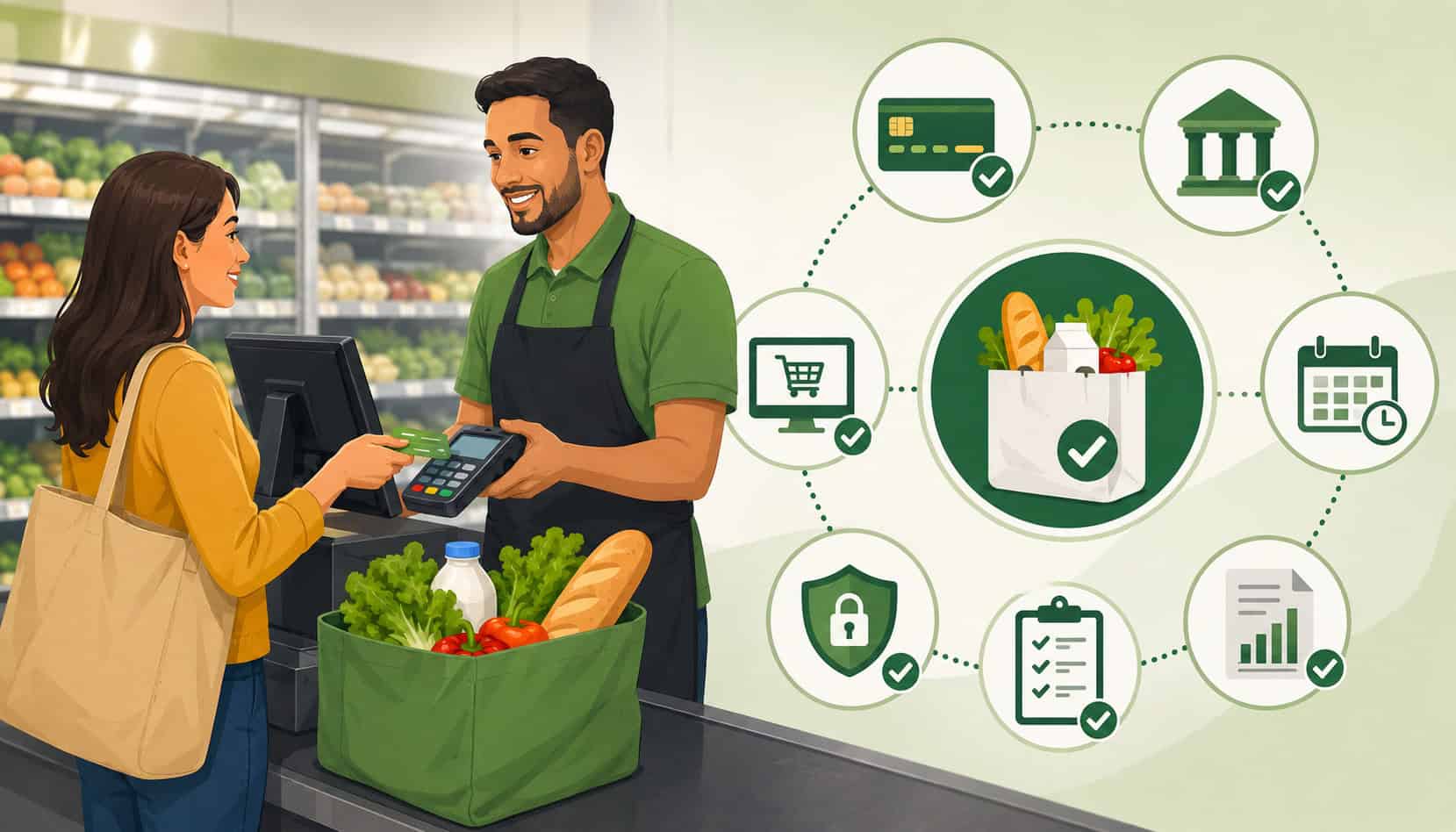
SNAP payment processing for merchants helps food retailers serve customers who rely on EBT cards for eligible grocery purchases.
For grocery stores, convenience stores, specialty food shops, farmers markets, and market operators, accepting SNAP payments can improve customer accessibility, reduce checkout friction, and support a more inclusive payment experience.
At the same time, SNAP EBT payment processing is not the same as ordinary card acceptance. Merchants must use approved payment systems, separate eligible and non-eligible items correctly, protect customer payment information, train employees, and follow retailer rules.
Authorized SNAP stores must use EBT equipment and transaction services so shoppers can pay for eligible food with benefits.
A strong setup includes reliable EBT payment terminals, secure EBT processing, accurate item files, clear receipts, stable connectivity, and staff who understand what can and cannot be purchased.
When these pieces work together, merchants can process grocery store SNAP payments smoothly while maintaining compliance and customer trust.
What Is SNAP Payment Processing for Merchants?
SNAP payment processing for merchants is the system that allows approved food retailers to accept EBT cards for eligible food purchases. Customers use an EBT card at checkout, enter a PIN, and the transaction is routed through an authorized payment network to confirm available benefits and approve the sale.
For the merchant, the process looks similar to debit card acceptance, but the rules are different. The payment system must identify which products are eligible, separate eligible food items from restricted items, and process only the approved portion through SNAP benefits.
If a customer buys both eligible groceries and non-eligible products in the same basket, the checkout system must support split tender or another compliant workflow.
SNAP EBT payment processing typically involves:
- An approved merchant setup
- EBT-enabled POS software or a stand-beside terminal
- Product eligibility controls
- PIN-based customer authentication
- Transaction approval and receipt generation
- Settlement and reconciliation reporting
The goal is simple: allow customers to buy approved food items while helping merchants maintain accurate, secure, and compliant transactions.
How SNAP EBT Payment Processing Works
A SNAP EBT payment begins when the cashier rings up the customer’s items. The POS system or terminal identifies which products are SNAP-eligible and calculates the eligible total. The customer then presents an EBT card and enters a PIN on the terminal.
The transaction is sent for authorization. The system checks the card status, available benefit balance, merchant authorization, and eligible transaction amount. If approved, the eligible portion is deducted from the customer’s benefit balance, and the merchant receives an approval response.
A typical transaction flow includes:
- Items are scanned or entered.
- The POS separates eligible and non-eligible products.
- The customer selects EBT as the payment method.
- The card is swiped, inserted, tapped, or keyed depending on terminal support.
- The customer enters a PIN.
- The system verifies available benefits.
- The eligible amount is approved or declined.
- A receipt is printed or sent electronically.
- The transaction appears in daily reporting and settlement records.
If the customer’s benefit balance is not enough to cover the eligible total, the system may allow partial approval or split tender. The remaining balance can be paid with another accepted payment method, depending on the merchant’s checkout setup.
Types of Merchants That Accept SNAP Payments
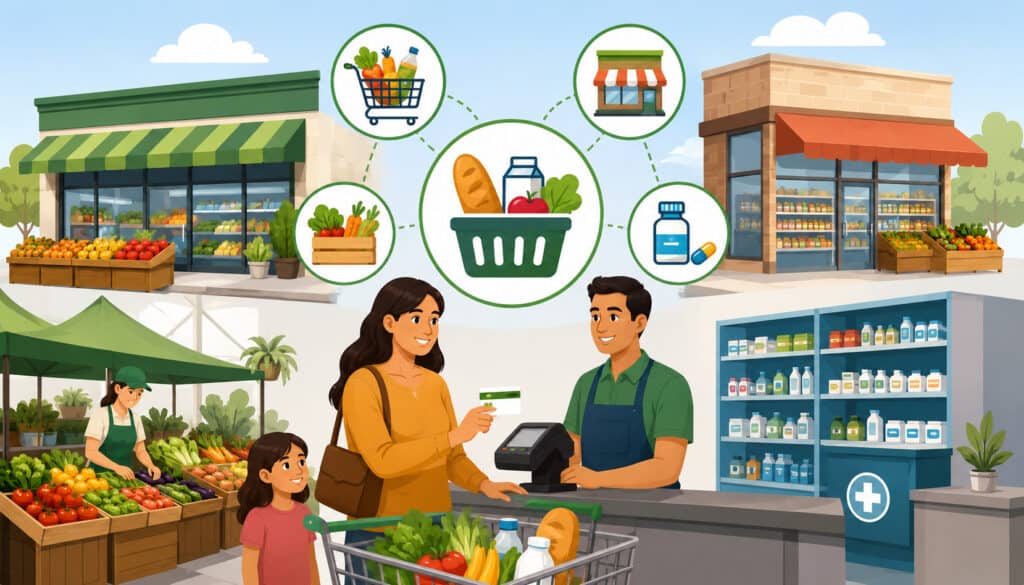
SNAP payment processing for merchants is most common in food retail environments where customers buy staple foods, groceries, packaged food, fresh produce, dairy products, bread, cereal, meat, poultry, fish, and similar eligible items.
Retailer eligibility generally depends on staple food inventory or staple food sales. Food and Nutrition Service guidance identifies four staple food categories: vegetables or fruits, dairy products, meat/poultry/fish, and breads or cereals.
Different merchants need different EBT payment solutions for merchants. A supermarket may require integrated lanes, scale support, inventory syncing, and high-volume reporting. A farmers market may need mobile terminals, wireless connectivity, and flexible vendor workflows. A convenience store may need fast checkout, clear item mapping, and simple staff training.
| Merchant Type | Typical SNAP Products | Payment Processing Needs |
| Grocery stores | Produce, dairy, meat, bread, cereal, pantry goods | Integrated POS, fast lanes, inventory tracking, reporting |
| Convenience stores | Packaged foods, beverages, dairy, snacks, basic groceries | EBT-enabled terminals, item eligibility controls, split tender |
| Farmers markets | Fruits, vegetables, herbs, local food items | Mobile EBT terminals, wireless processing, market-level tracking |
| Specialty food stores | Meat, seafood, bakery items, ethnic groceries | Product mapping, scale integration, clear receipts |
| Local food businesses | Eligible packaged or staple food items | Simple EBT setup, staff training, transaction records |
| Online grocery services | Eligible food orders | Approved online EBT workflow, digital item eligibility controls |
Grocery Stores and Supermarkets
Grocery stores and supermarkets often process high volumes of EBT transactions every day. Their systems must support quick checkout, accurate item eligibility, customer privacy, receipt clarity, and reliable settlement reporting. Because these stores sell both eligible and non-eligible products, the POS must separate items correctly before payment.
Integrated SNAP payment systems are especially useful in larger stores. They can connect EBT card processing for retailers with inventory, pricing, scale items, tax settings, refunds, and cashier permissions. This reduces manual work and helps prevent checkout errors.
For grocery store SNAP payments, speed matters. Customers expect EBT transactions to move as smoothly as debit transactions. Delays caused by poor item mapping, outdated terminals, or weak connectivity can create frustration for customers and cashiers.
Convenience Stores and Small Retailers
Convenience stores and small retailers can benefit from merchant EBT processing when they sell eligible staple food items. Many smaller merchants use stand-beside EBT payment terminals or compact POS systems because they are easier to install, train on, and maintain.
The biggest challenge for small retailers is accuracy. A small store may sell groceries, beverages, household goods, tobacco, hot foods, and other restricted items in the same checkout flow. Without proper item categorization, staff may accidentally attempt to process non-eligible items through EBT.
Small retailers should look for systems that support:
- EBT card acceptance
- Split tender
- Clear transaction prompts
- Daily EBT reporting
- Receipt printing
- Simple refund and void workflows
- Secure PIN entry
A helpful comparison of terminal setups can be found in this guide to integrated vs. stand-beside EBT terminals.
Farmers Markets and Specialty Food Merchants
Farmers markets, specialty food merchants, and mobile vendors often need flexible EBT payment solutions. Unlike a fixed grocery store checkout lane, these merchants may operate outdoors, at temporary locations, or across multiple booths. That makes mobile and wireless EBT processing especially important.
A farmers market may use a central terminal at the market manager booth or individual mobile terminals for vendors. Specialty food merchants may need scale integration, PLU support, and workflows for products sold by weight.
Mobile EBT systems help merchants serve customers without requiring a permanent checkout counter. However, they depend on battery life, wireless coverage, reliable devices, and clear staff procedures.
For a deeper operational look, merchants can review this resource on farmers market EBT acceptance.
Equipment and Technology Needed for SNAP Payment Processing
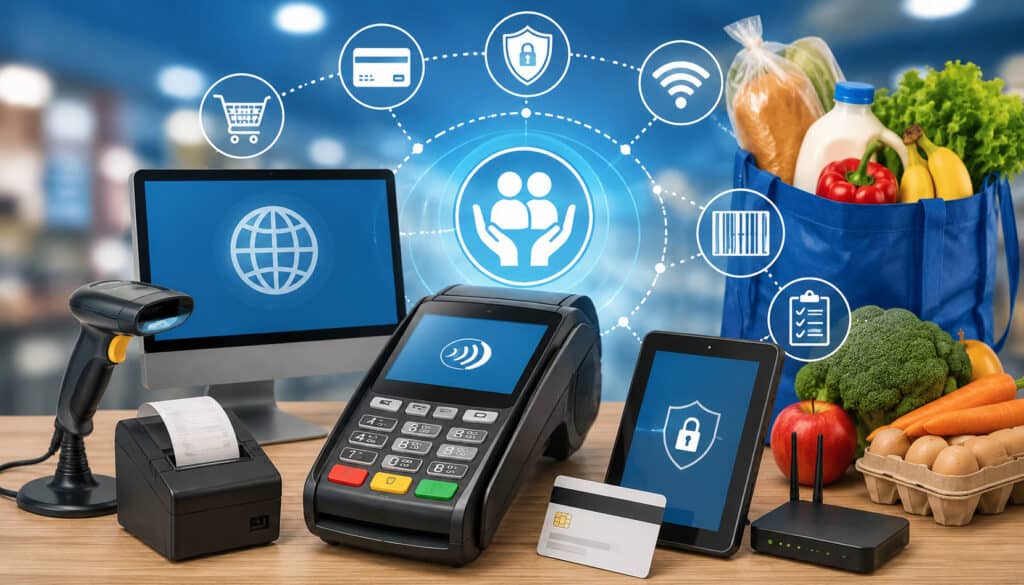
To accept SNAP payments, merchants need technology that supports EBT transaction routing, PIN entry, receipt generation, and secure communication. The exact equipment depends on store size, checkout volume, location type, and whether the merchant uses integrated or standalone systems.
Core equipment may include:
- EBT-enabled POS system
- EBT payment terminals
- PIN pad
- Receipt printer
- Barcode scanner
- Cash drawer
- Secure internet connection
- Mobile or wireless processing device
- Back-office reporting software
- Inventory and item eligibility tools
Secure EBT processing also requires proper device management. Terminals should be sourced from reputable providers, kept updated, physically inspected, and protected from tampering. Payment systems should support encryption and secure PIN entry.
Merchants should also consider redundancy. If the internet connection goes down or a terminal fails, the store needs a procedure for handling affected transactions. That may include backup equipment, support contacts, or clear instructions for staff.
EBT-Compatible POS Systems
An EBT-compatible POS system should do more than accept a card. It should support SNAP item eligibility, mixed baskets, split tender, refunds, voids, transaction reporting, and cashier permissions. For stores with many SKUs, item-level controls are essential.
When evaluating a POS system, merchants should ask:
- Does it support SNAP EBT payment processing?
- Can it separate eligible and non-eligible items automatically?
- Does it handle partial approvals?
- Can it process refunds and voids correctly?
- Does it integrate with inventory?
- Can managers review EBT transaction reports?
- Does it support scale items and PLUs?
- Are software updates handled regularly?
Integrated POS systems can reduce errors because the checkout, inventory, and reporting systems work together. Standalone systems may be easier for small retailers but often require more manual reconciliation.
A useful operational reference is this guide to managing SNAP-eligible item files.
Mobile and Wireless EBT Processing
Mobile and wireless EBT processing helps merchants accept payments in flexible checkout environments. This is useful for farmers markets, mobile produce sellers, pop-up food events, temporary retail spaces, and specialty merchants that do not operate from a traditional register lane.
A mobile EBT setup usually includes a wireless terminal or mobile POS device, secure connection, receipt capability, and access to transaction reporting. The device must allow secure PIN entry and route transactions through approved systems.
Merchants should consider:
- Wireless coverage
- Battery life
- Device durability
- Receipt options
- Offline limitations
- Staff login controls
- Refund and void access
- End-of-day reporting
Mobile devices can improve customer convenience, but only if they are reliable. A slow or disconnected terminal can create long lines and lost sales.
SNAP Compliance Requirements for Merchants
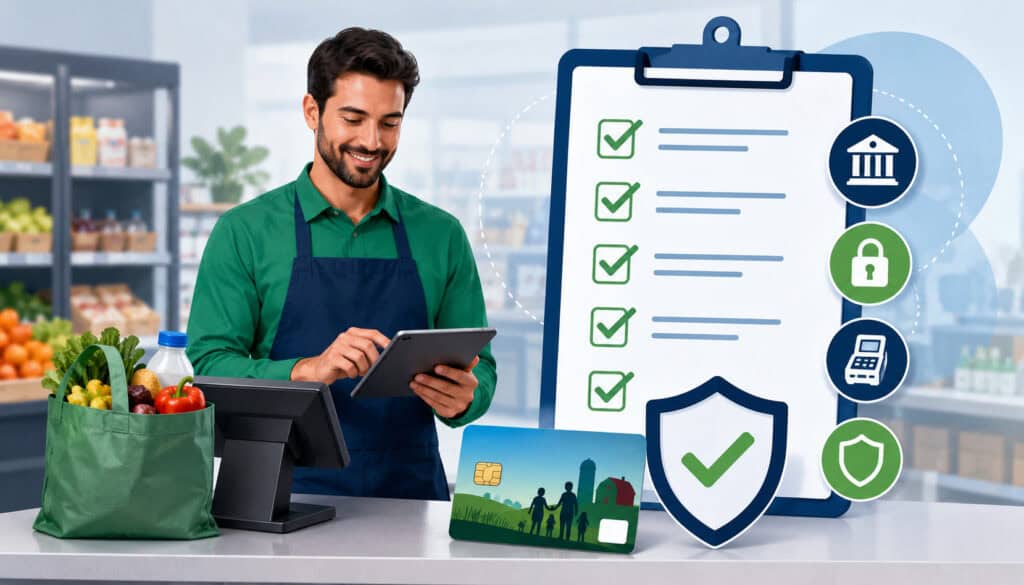
SNAP compliance for merchants begins before the first transaction. Retailers must be authorized, maintain eligible inventory or sales qualifications, follow product rules, and use approved EBT transaction services.
Store eligibility may be based on staple food inventory or staple food sales, with staple foods grouped into vegetables/fruits, dairy, meat/poultry/fish, and breads/cereals.
Compliance does not stop after approval. Merchants are responsible for how transactions are handled at the register, how staff behave, how items are categorized, and how records are maintained.
Retailer employees should be trained before redeeming benefits, and retailer management rules require ongoing attention to authorization and system access.
Key compliance areas include:
- Selling only eligible food items through SNAP benefits
- Not allowing prohibited items through EBT
- Avoiding cash exchange for benefits
- Treating SNAP customers consistently
- Keeping accurate transaction records
- Training cashiers and managers
- Maintaining working equipment
- Monitoring suspicious transaction patterns
- Updating business information when ownership, location, or banking details change
Merchants should also understand that prepared or heated foods and accessory foods are treated differently from staple foods under eligibility guidance.
Payment Security and Fraud Prevention for EBT Transactions
Secure EBT processing protects customers, merchants, and the integrity of food assistance payment processing. EBT transactions involve PIN-based authentication, sensitive account data, and strict program rules. A careless security setup can expose the store to fraud, disputes, investigations, and customer trust problems.
Security starts with approved hardware and software. Terminals should be encrypted, tamper-resistant, and maintained with current software. Employees should never ask customers to reveal a PIN, write down card information, or hand over control of the payment process beyond standard terminal use.
Fraud prevention also includes operational controls. Managers should review unusual transaction patterns, monitor cashier activity, restrict refund permissions, and investigate repeated errors. Stores should pay attention to rapid repeat transactions, unusually high EBT totals, excessive manual entries, and transactions that do not match normal sales patterns.
A deeper security resource is available here: EBT transaction security and fraud prevention.
Protecting Customer Payment Information
Customer payment information must be handled with care. EBT customers should enter their own PIN privately, without cashier involvement. Terminals should be positioned so customers can shield the keypad from view while still allowing staff to complete the transaction efficiently.
Merchants should avoid unsafe practices such as storing card numbers, taking photos of cards, writing down customer data, or asking customers to share benefit balances out loud. Balance inquiries and receipts should be handled discreetly.
Staff should also understand that privacy is part of customer service. Customers using EBT should not be singled out, rushed, questioned unnecessarily, or treated differently at checkout.
Good protection practices include:
- Secure PIN pads
- Customer-controlled PIN entry
- Encrypted terminals
- Limited employee access
- No handwritten card data
- Secure receipts
- Regular device checks
Reducing Transaction Errors and Disputes
Many EBT problems come from avoidable checkout mistakes. Incorrect item categorization, rushed cashier actions, unclear receipts, and poor refund handling can create disputes or failed transactions.
The best way to reduce errors is to combine technology and training. POS systems should automatically identify eligible products, while staff should know how to handle exceptions. Managers should review declined transactions, voids, refunds, and split-tender issues to identify patterns.
Receipts are especially important. A clear receipt helps customers understand what was paid with EBT, what remains due, and whether any items were not eligible. It also gives the merchant a transaction record if a question arises later.
Merchants can strengthen dispute prevention by:
- Training staff on mixed baskets
- Maintaining accurate UPC and PLU files
- Reviewing refunds and voids
- Keeping receipt records
- Using manager approval for unusual transactions
- Reconciling EBT totals daily
Common Challenges With SNAP EBT Payment Processing
Even well-run stores can face challenges with SNAP EBT payment processing. Most issues fall into a few categories: technology, item eligibility, training, connectivity, reporting, and compliance.
Technical issues may include terminal downtime, failed PIN pad communication, software update problems, printer failures, or slow authorization responses. These problems can delay checkout and frustrate customers.
Connectivity is another common issue. EBT payment terminals need a reliable connection to authorize transactions. Mobile merchants and outdoor markets are especially vulnerable to weak signals.
Item categorization errors can also create problems. If eligible items are not marked correctly, customers may be forced to use another payment method. If non-eligible items are incorrectly allowed, the store may face compliance risk.
Common challenges include:
- Declined transactions
- Partial approvals
- Mixed eligible and non-eligible baskets
- Outdated product files
- Staff confusion
- Refund mistakes
- Connectivity failures
- Settlement mismatches
- Terminal downtime
- Incomplete records
Benefits of Accepting SNAP Payments for Merchants
Accepting SNAP payments helps merchants serve more customers and improve checkout accessibility. For food retailers, EBT acceptance can be an important part of meeting community shopping needs and offering flexible payment options.
The business benefits include more inclusive payment acceptance, broader customer reach, stronger customer loyalty, and improved convenience for shoppers who depend on EBT benefits for groceries. Customers are more likely to return to stores where they can complete grocery purchases smoothly and respectfully.
Merchant benefits may include:
- More accessible checkout options
- Better service for grocery customers
- Increased transaction opportunities
- Stronger local customer relationships
- Improved competitiveness among food retailers
- Support for multi-payment checkout workflows
- Better reporting through modern POS tools
EBT payment solutions for merchants can also modernize store operations. Integrated systems can improve inventory tracking, reduce manual reconciliation, and help managers understand SNAP-related sales activity.
How to Choose the Right EBT Payment Solutions for Merchants
Choosing the right EBT payment solutions for merchants requires looking beyond price. The best solution should match your checkout volume, product mix, staff skill level, store layout, reporting needs, and compliance obligations.
Start with the basics. Confirm that the processor and equipment support SNAP EBT payment processing, secure PIN entry, EBT reporting, split tender, refunds, voids, and customer receipts. Then evaluate how well the solution fits your store’s workflow.
Important selection factors include:
- EBT compatibility
- POS integration
- Terminal reliability
- Security features
- Reporting tools
- Customer support
- Staff training resources
- Settlement visibility
- Refund and void controls
- Multi-location support
- Mobile processing options
- Hardware replacement support
Merchants should also ask who handles support when something goes wrong. Some issues belong to the POS vendor, some to the payment processor, and some to the EBT network or help desk. Knowing the escalation path saves time during checkout disruptions.
Payment Reporting and Reconciliation Features
Reporting is one of the most important features in merchant EBT processing. Without clear reports, managers may struggle to reconcile daily totals, identify errors, track refunds, and monitor transaction patterns.
A good reporting system should show approved EBT transactions, declined attempts, refunds, voids, batch totals, settlement activity, cashier activity, and transaction timestamps. It should also make it easy to compare POS totals with processor records.
Daily reconciliation helps catch problems early. If a cashier processes an incorrect refund, a terminal goes offline, or a batch total does not match, managers can investigate before the issue grows.
Useful reporting features include:
- Daily EBT transaction summaries
- Register-level reporting
- Cashier-level reporting
- Refund and void logs
- Settlement reports
- Exception reports
- Exportable records
- Multi-location dashboards
Integration With Retail POS Systems
POS integration improves checkout speed, inventory accuracy, reporting, and compliance. When EBT card processing for retailers is connected directly to the POS, eligible items can be identified automatically, and transaction details can flow into reports without duplicate entry.
Integrated systems are especially helpful for stores with large inventories, multiple lanes, scale items, frequent price changes, or multiple locations. They reduce the need for manual entry and help keep item eligibility consistent.
Integration can improve:
- Checkout speed
- Item-level accuracy
- Split-tender handling
- Inventory updates
- Sales reporting
- Refund workflows
- Employee permissions
- Transaction tracking
- Reconciliation
Standalone terminals still have a place, especially for smaller retailers or temporary setups. However, merchants should understand the tradeoff: standalone systems may be easier to deploy, while integrated systems often provide stronger long-term operational control.
Common Mistakes Merchants Should Avoid
Many SNAP payment problems are preventable. Merchants often run into trouble when they treat setup as a one-time task instead of an ongoing operating responsibility.
One common mistake is using unsupported or outdated terminals. Older equipment may process slowly, fail security expectations, or create transaction errors. Another mistake is failing to train staff beyond the basics. Cashiers need to understand eligibility, split tender, declined transactions, refunds, privacy, and escalation procedures.
Merchants should avoid:
- Using unsupported EBT terminals
- Failing to train new employees
- Allowing non-eligible items through SNAP
- Misclassifying hot or prepared foods
- Ignoring item file maintenance
- Skipping daily reconciliation
- Weak terminal security
- Poor refund documentation
- Not reviewing transaction reports
- Treating EBT customers differently
- Waiting too long to fix recurring errors
Another major mistake is poor documentation. If a dispute, audit, or investigation occurs, accurate records can help show what happened. Missing records make it harder to explain legitimate transactions.
Best Practices for SNAP Payment Processing for Merchants
The best SNAP payment systems combine compliant technology, trained people, and consistent operating routines. Merchants should not rely only on the terminal or only on staff judgment. A strong process uses both.
Best practices include:
- Use approved EBT-enabled payment equipment.
- Keep POS software and terminals updated.
- Train all cashiers before they process EBT transactions.
- Maintain accurate SNAP-eligible item files.
- Review mixed-basket and split-tender procedures.
- Protect customer PIN privacy.
- Inspect terminals for tampering.
- Reconcile EBT transactions daily.
- Review refund and void activity.
- Monitor unusual transaction patterns.
- Keep clear records.
- Update procedures when rules or systems change.
Staff training should be ongoing. New employees need onboarding, while experienced employees need refreshers when equipment, item files, or procedures change.
Managers should also review customer experience. Accepting SNAP payments is not only about compliance. It is also about making checkout respectful, efficient, and consistent.
FAQs
What is SNAP payment processing for merchants?
SNAP payment processing for merchants is the process that allows authorized food retailers to accept EBT cards for eligible food purchases. It involves approved payment terminals, secure PIN entry, item eligibility controls, authorization, receipt generation, settlement, and reporting.
How do merchants accept SNAP EBT payments?
Merchants accept SNAP EBT payments by becoming authorized, setting up EBT-enabled equipment, configuring eligible items in the POS, and processing customer transactions through an approved system. At checkout, the customer uses an EBT card and enters a PIN to authorize the eligible purchase amount.
What equipment is needed for EBT processing?
Most merchants need an EBT-compatible POS system or stand-beside terminal, PIN pad, receipt printer, secure connection, and reporting tools. Larger retailers may also need barcode scanners, scale integration, inventory software, and multi-lane POS integration.
Which businesses can accept SNAP payments?
Common SNAP merchants include grocery stores, supermarkets, convenience stores, farmers markets, specialty food retailers, and certain local food businesses that sell eligible staple foods. Retailer eligibility depends on inventory, sales, authorization, and compliance with program rules.
Are SNAP transactions secure?
SNAP transactions can be secure when merchants use approved terminals, encrypted processing, secure PIN entry, restricted employee access, and regular device inspections. Security also depends on staff training, fraud monitoring, and proper handling of receipts and transaction records.
Can mobile devices process EBT payments?
Yes, mobile and wireless EBT processing can support merchants that operate in flexible environments, such as farmers markets, temporary food retail setups, and mobile food businesses. Merchants should confirm that the device supports secure PIN entry, reliable connectivity, receipts, and reporting.
How can merchants reduce SNAP transaction errors?
Merchants can reduce SNAP transaction errors by training staff, keeping item files updated, using integrated POS tools, reviewing declined transactions, reconciling daily reports, and documenting refunds and voids. Clear receipt details and accurate product categorization are especially important.
What should merchants look for in EBT payment solutions?
Merchants should look for EBT compatibility, secure terminals, POS integration, split-tender support, reporting tools, refund and void workflows, reliable support, and scalability. The right solution should fit the merchant’s checkout volume, product mix, and compliance needs.
Conclusion
SNAP payment processing for merchants helps food retailers serve more customers, improve payment accessibility, and support compliant grocery transactions. With the right EBT payment terminals, secure processing tools, accurate POS setup, and trained employees, merchants can make accepting SNAP payments smoother for both customers and staff.
Successful EBT payment processing is built on consistency. Merchants need reliable technology, clear item eligibility controls, careful recordkeeping, strong security habits, and practical staff training. When these elements work together, SNAP EBT payment processing becomes a dependable part of modern checkout operations.
For grocery stores, convenience stores, farmers markets, specialty food merchants, and business managers, the best approach is proactive: choose the right system, maintain it carefully, train your team, monitor compliance, and keep improving the checkout experience.