By Julia Koroleva March 12, 2026
Selecting the best platform for SNAP online purchasing involves comprehension of the FNS BRD business requirements document and assessment of its relevance to your system.
Retailers have the responsibility to see that their website, payment process, and documentation are in line with the standards defined by the Food and Nutrition Service.
Well-thought-out system design, accurate documentation, and coordination with the vendor are factors that will help to make sure that the application for SNAP Online Purchasing proceeds without problems for successful approval.
Basic Requirements to Accept SNAP EBT Payments Online

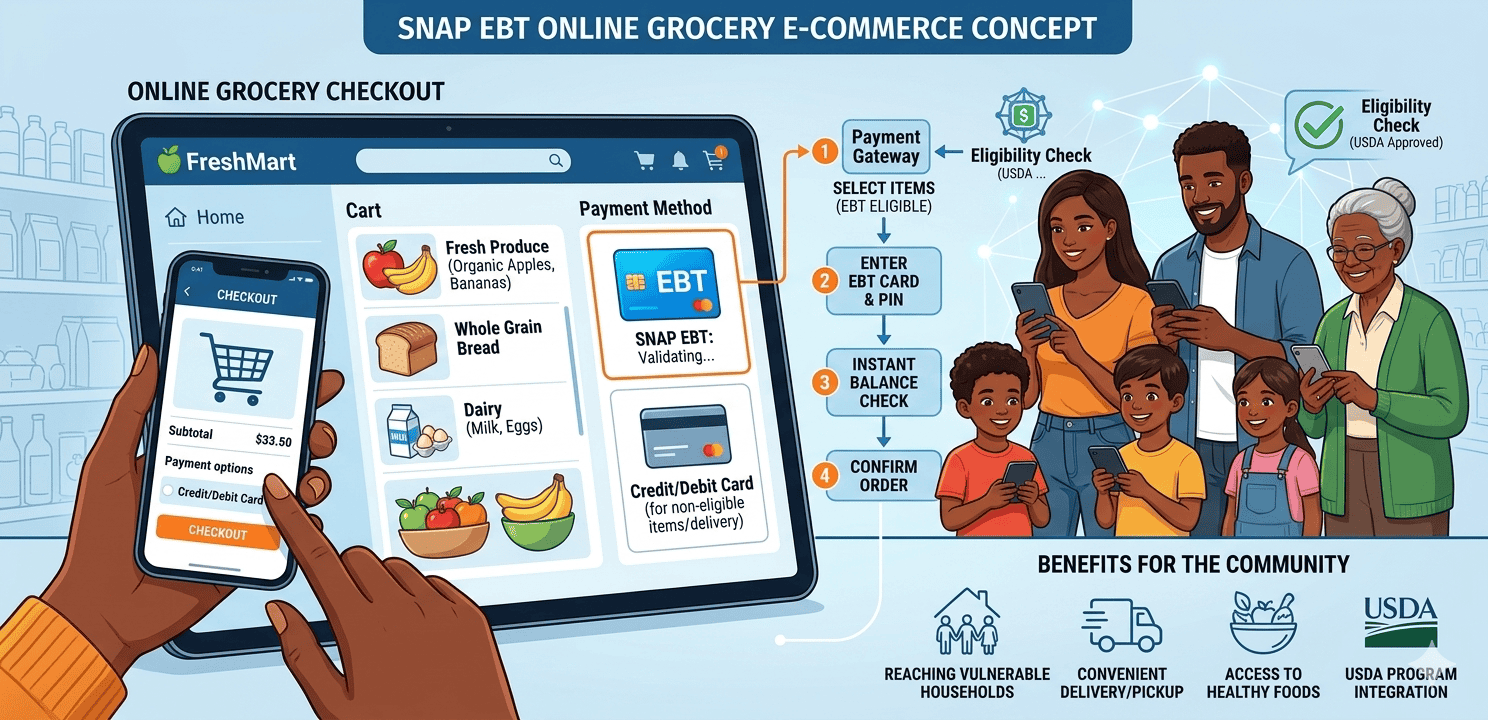
Retailers need to fulfill various conditions to accept SNAP EBT payments online. Initially, the shop must be authorized to accept SNAP benefits by the United States Department of Agriculture. Only such approved SNAP retailers can get the online purchasing program.
The company also must have an operational online store, like a website or a mobile app, where clients can place their orders safely. Moreover, the systems have to enable secure EBT PIN entry and be compatible with payment processors that are approved. Besides that, the system should be able to identify the SNAP eligible products correctly, and also prevent the usage of benefits for the purchase of non-eligible items.
Additionally, the platform must facilitate split payments and submit a Letter of Intent for the SNAP Online Purchasing Program.
FNS Requirements for Choosing a SNAP EBT Ecommerce Platform
To receive SNAP EBT payments through the internet, a company has to confirm that its electronic commerce platform complies with the rules of the Food and Nutrition Service (FNS). Here are the main regulations that a business needs to follow:
Website Capability for Online SNAP Purchasing: The e-commerce platform should be versatile and able to be changed to meet the requirements of SNAP EBT online purchasing.
Secure Pin Entry Integration: The platform should allow secure online PIN entry by integrating a third-party processor (TPP) through an API to process SNAP transactions safely.
Error Handling System: The website should give customers clear and informative error messages whenever an error arises that limits them from going on with checkout or payment.
Refund Processing: Refund processing is linked to the original purchase. The software should correlate the refund with the original SNAP transaction to make sure that benefits are returned properly.
Support for Estimated Pricing: The platform should be capable of dealing with products measured by weight, e.g., groceries, where the total prices may differ a little.
Single SNAP Card Per Account: A customer account should only be linked to one SNAP card to stay compliant and avoid misuse.
Restriction on Non-eligible Items: The system needs to make sure that SNAP benefits are only used for buying eligible food items, and it should also block non-eligible products.
No Sales Tax on SNAP Purchases: During checkout, the system must be able to recognize SNAP eligible items and not charge sales tax to those items.
Split Tender Payment Support: The platform should provide customers with the option of using SNAP for their eligible foods and a different payment method for their non-eligible items or delivery charges.
Meeting Additional FNS Online Purchasing Requirements: Businesses must adhere to all the other requirements given in the official Online Purchasing Request guidelines, along with the following steps:
BRD Expectations for Choosing an E-Commerce Platform for SNAP EBT Online
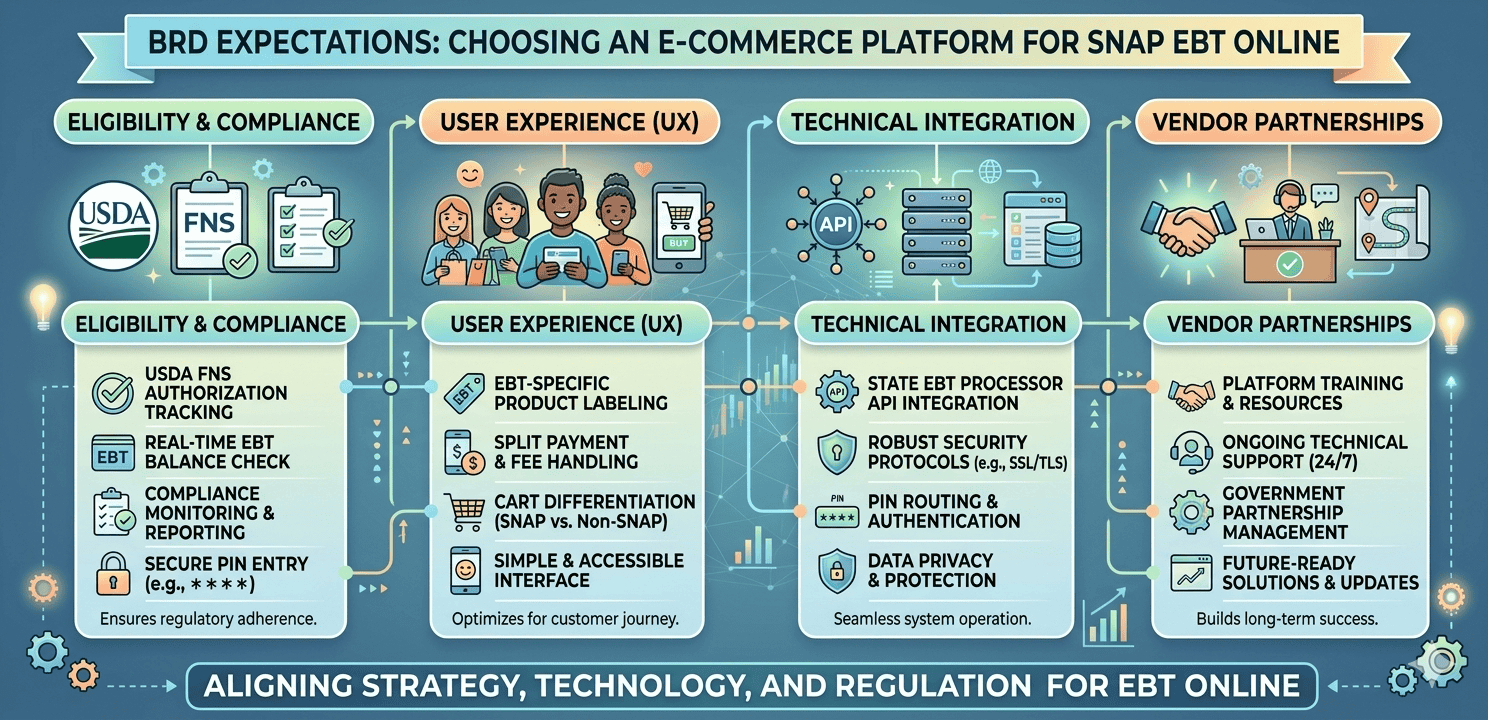
This guidance clarifies the details that retailers should put in their system documentation to support SNAP Online Purchasing websites and systems. The document is sent to the Food and Nutrition Service as a Business Requirements Document (BRD). The objective is to visually depict how your system functions, how EBT transactions are handled, and how your platform complies with the SNAP Online requirements as outlined in the RFV guidelines. Besides that, it allows the review team to prepare testing scenarios based on your system.
Microsoft Word Format
Firstly, the extent of EBT integration can be different for every retailer. Some platforms may only need minor updates while others may require major system changes. Retailers may follow their own style of documentation, but the final BRD should be in Microsoft Word format.
Screenshots and Captions
Secondly, your BRD may have process flows, screenshots, wireframes, links, use cases, and descriptive explanations of how transactions operate. Screenshots need to have captions that describe the content. If part of the section is not relevant to your system, explain briefly why it is not applicable, and don’t delete it.
Current Website Terms & Conditions
Detail the terms and conditions of your website that are currently in place and generally suitable for all customers. Point out the changes that would be necessary if you want to accept online SNAP EBT payments and transactions.
EBT Specific Additions
Include segments in the policy that illustrate in detail the method of EBT payment, the rules of eligibility, and the limitations of SNAP purchases, if any.
EBT Related Help/FAQs
Develop a help or FAQ part that provides answers to the typical inquiries about the use of EBT online problems with payment, what items are eligible, and the steps in the checkout process.
Secure Card Number Storage
Explain how the platform either securely stores or processes EBT card information while adhering to security standards and protecting customer data.
Account Setup and User Preferences
Describe how customers are offered the option of creating an account, adding EBT cards, and managing their preferences, such as payment methods, delivery options, and saved details.
Cookies
Mention it some cookies here are used for login sessions, user preferences, tracking activity, and improving the shopping experience.
Online EBT Fraud Mitigation Measures
List activities for preventing fraud, e.g., account verification, transaction monitoring, and system checks for suspicious activity.
Add EBT Payment Option
The EBT payment option is explained as being introduced at checkout, and how customers can select it during the payment process.
Identify and Limit SNAP Eligible Items and EBT Cash Eligible
An automated system identifies SNAP, eligible products, and it is ensured through the system that only products allowed for use with SNAP benefits are purchased.
Add Items to Cart
Show customers are allowed to browse products and add SNAP-eligible items to their cart while shopping online.
Balance Inquiries
Customers can obtain information about their EBT balance at the time of checkout or even before making a purchase.
Manage or Change Items in Cart
Before payment, customers can change quantities, remove products, or substitute items in their cart.
Provide Delivery, Store Pickup, or Shipping Options
Explain the process for customers to select delivery, store pickup, or shipping options, highlighting compliance with SNAP regulations.
Facilitate EBT Customer Payments and Split Tender Payments
Describe how the system allows for split payments if part of the order is paid through EBT and the rest with another payment method.
Successful Post, Payment, and Order Processing
Define post, payment activities, including order confirmation, receipt issuance, and order processing.
Post, Payment Online Order Modifications
Detail how customers make post, payment order changes, if permitted, and how the system handles those changes.
Refunds and Post, Payment Order Cancellation
Describe how cancellations and refunds are made, including how refunds are restored to the original payment method.
More Refund Scenarios
You can talk about partial refunds, item substitutions, or out-of-stock products and the method of handling refunds in each case.
Error Handling for Declined Transactions
You need to explain the messages that customers see when their transactions are unsuccessful. The system is expected to give users instructions on the next step, for instance, to try the payment again or to use a different one.
Automated Reversals and System Error Handling
Elaborate on how the system deals with automatic reversals, technical problems, and situations that call for retailer intervention.
Error Codes and Customer Messaging
Based on the response requirements, prepare an error code list with corresponding customer message samples for EBT online transactions.
Vendor Questions to Ask Before Choosing an eCommerce Platform for SNAP EBT Online
Contract Requirements and Services
- What is the length of the contract?
- What is the minimum contract period available?
- What is the maximum contract period available?
- How does the contract length affect pricing?
- Does the contract renew automatically?
- Are there penalties for early termination?
- If yes, how much is the early termination penalty?
- How much advance notice is required for termination without penalty?
- Who is responsible for different parts of the online storefront?
- Does the eCommerce provider only support payment processing?
- Does the eCommerce provider also provide an online storefront connected to the retailer’s inventory system?
- How are service fees paid?
- Are service fees taken through direct debit from the retailer’s bank account?
- If yes, are payments deducted daily or monthly?
- Can fees be billed and paid by check?
- Can fees be paid through ACH transfer?
- Is any type of insurance required?
Additional Important Questions
- Is 24×7 customer support available from the eCommerce provider for resolving online transaction issues?
- Does the provider schedule downtime for system maintenance?
- When is regular maintenance usually scheduled?
- What is the average downtime during maintenance?
Costs
- What are all the costs involved in the service?
- Are there additional charges for certain services?
- Are there upfront or one-time implementation fees?
- Are there onboarding costs?
- Does onboarding include testing support?
- Are testing and onboarding charges fixed or based on the hours of support provided?
- What are the transaction fees for each payment processed?
- What are the credit card transaction fees?
- What are the debit card transaction fees?
- Are there transaction fees for SNAP EBT payments?
- Are EBT transaction fees lower compared to credit or debit card fees?
- Does the provider offer tiered pricing based on transaction volume?
- How does the tiered pricing structure work?
- Are there providers that do not charge EBT transaction fees but instead charge a higher monthly fee?
Monthly Fees
- What monthly fees are charged by the provider?
- Are these services included in one combined monthly fee or charged separately?
- What is the cost for website support if the provider hosts the online storefront?
- Are there direct deposit processing fees?
- Is there a charge for monthly statements?
- Is customer service and technical support included in the monthly fee?
- Is there an additional fee for technical support?
- Does the provider offer online access to detailed transaction data?
- Does transaction data include date, time, amount, payment method, truncated card numbers, and transaction ID?
Other Ongoing Fees
- Are there PCI compliance fees?
- Do PCI compliance fees apply only to credit and debit transactions?
- Are PCI compliance fees charged for EBT-only transactions?
- Are there fees related to IRS reporting?
- Are there any other ongoing administrative fees?
- Are there any hidden fees that retailers should know about?
- How does the pricing compare with other eCommerce providers?
Company Performance and Reputation
- How reliable is the company’s service?
- What do other retailers say about the provider?
- Are there reviews or ratings available online?
- Can the company’s reputation be checked through business review websites?
Services
- If you already have an eCommerce provider, do they support EBT SNAP Online payments?
- If not, can they add EBT as a payment option?
- If the provider is adding EBT for the first time, do they understand the requirements for online EBT transaction processing?
- If the provider does not currently support EBT online, will additional documentation be required by USDA Food and Nutrition Service?
- Will a demonstration of the eCommerce solution be required for review?
- Which EBT payment options will you offer customers shopping online?
- Will you accept SNAP benefits?
- Will you accept EBT Cash?
- Will you also accept credit and debit cards?
- What services do you need from the eCommerce provider?
- Do you only need payment processing services?
- Do you want the provider to host and manage the full online storefront?
- Will the provider handle website design and product images?
- What is the average time from contract signing to starting online transactions?
- How long does it usually take to implement an online shopping store?
- Will implementation take longer if the provider is also building the storefront?
- Will implementation take longer if EBT payment options are being added for the first time?
Conclusion
Selecting a suitable online EBT payment gateway provider involves a great deal of well prepared documents and an in-depth comprehension of each system’s role. Before proceeding, merchants must thoroughly inspect the contract clauses, technical prerequisites, and the features of the platform. They should not forget that FNS does not endorse ecommerce providers; hence, companies need to make vendor selection decisions independently.
By abiding with the direction given by the Food and Nutrition Service, merchants are aided first in compliance and secondly in readiness of their systems for the SNAP Online Purchasing licensing.
FAQs
What is SNAP SEMTAC BRD help?
SNAP SEMTAC BRD help is a kind of assistance to retailers in the preparation of documentation that communicates system design, EBT processing flow, and compliance to the approval authority.
Why is the BRD necessary for SNAP online purchasing?
The reviewers can easily follow your platform and test transactions with a clear BRD by checking the requirements and confirming that the system properly supports secure EBT payments.
How do I select the best platform for SNAP online purchase?
You should compare platform integrations, security features, support for EBT processors, availability of reporting tools, and readiness for compliance when choosing the best platform for SNAP online purchase.
Do retailers have to prepare technical documentation before submitting an application?
Yes, retailers should document system flows, take screenshots, prepare payment logic explanations, and write down policies, demonstrating the ways EBT transactions and eligible items are handled.
Is it possible for an existing eCommerce platform to be used for SNAP EBT online?
If the platforms integrate with approved processors, facilitate secure PIN entry, and comply with the SNAP program technical and compliance requirements, many of them are capable of supporting it.