By Julia Koroleva March 27, 2026
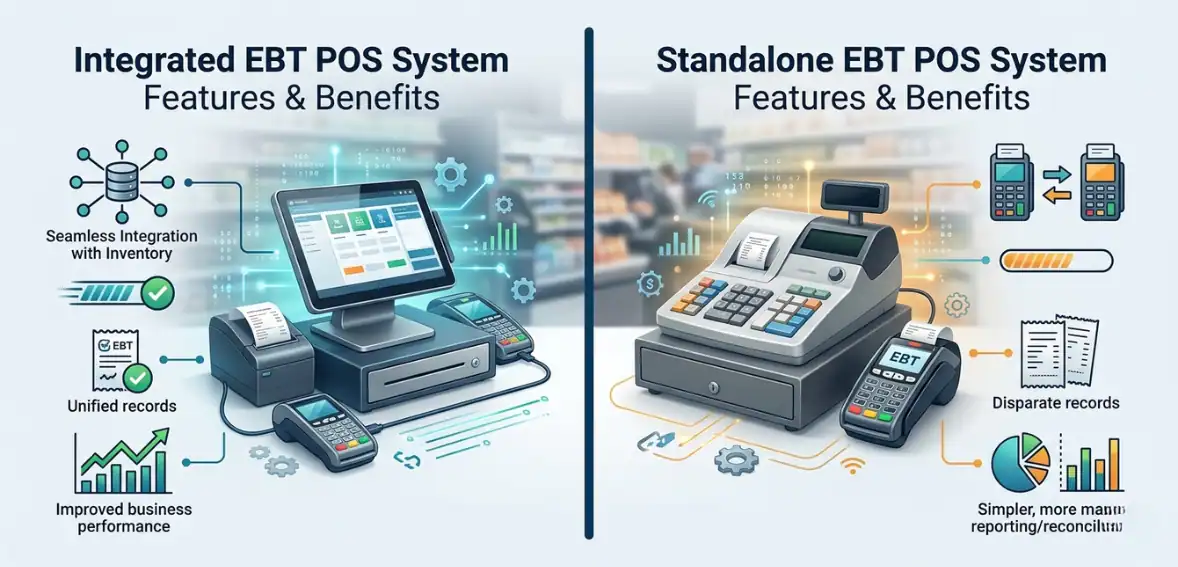
Choosing the right EBT setup is crucial for smooth checkout and compliance. Stores can use integrated EBT POS systems, where EBT terminals connect directly to inventory and sales software, or stand-alone EBT terminals that operate independently. Each SNAP EBT terminal option has tradeoffs in speed, reporting, training, and costs. Understanding these differences helps retailers select the solution that fits their store size, workflow, and long-term growth plans.
What Is a Standalone POS System for SNAP EBT?
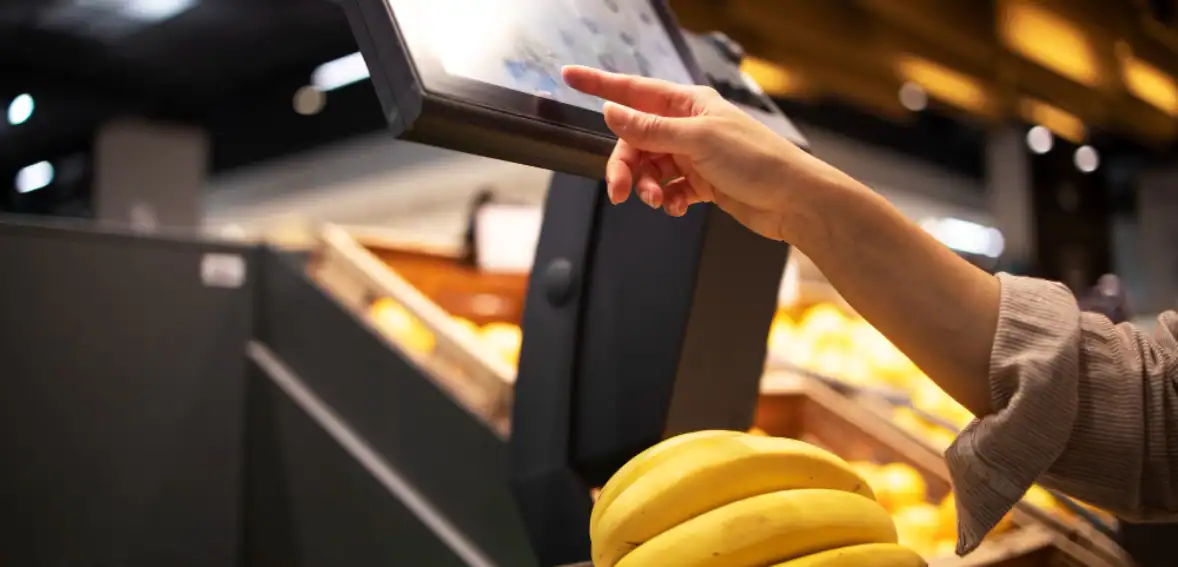
A standalone POS system for SNAP EBT provides a simple, all-in-one payment solution that runs independently without requiring a connection to other business software. It enables retail outlets to accept EBT payments efficiently and conveniently, making it ideal for merchants seeking a simple solution without dealing with complex systems or integrations.
Such a POS system is developed to perform SNAP transactions effectively during checkout. The emphasis is on speed, dependability, and user-friendliness, which is crucial in busy stores where prompt service is essential. Being independent, it requires minimal setup, and employees can be trained to use it quickly.
A typical standalone POS system for SNAP EBT includes:
- A card reader or payment terminal for EBT cards
- Simple sales tracking to track transactions
- Receipt printing for customers
- Simple reporting to view daily sales
- No reliance on other POS or accounting systems
These systems are ideal for small grocery stores, convenience stores, and markets that primarily need to process SNAP transactions without complex features. They will help eliminate confusion at checkout, meet SNAP fee rules, and run your business smoothly.
Benefits of Standalone POS Systems
In terms of practicality, standalone POS systems offer several benefits for businesses that accept SNAP EBT.
Firstly, they’re very easy to operate, so employees can quickly become familiar with performing EBT transactions with very little training. This, in turn, reduces the number of mistakes at the checkout.
Besides, their adaptability enables them to be used in different places, for example, at markets or temporary setups, and some of them can even process SNAP EBT transactions when network problems occur. Since they don’t require much hardware, these POS systems are dependable, easy to use, and, most importantly, ensure EBT payment processing runs smoothly.
Standalone POS Systems for SNAP EBT: Limitations to Keep in Mind
There are drawbacks to stand-alone POS systems for SNAP EBT that businesses should be aware of.
Firstly, they can handle basic transactions, but these systems offer very little business insight, which makes it difficult to track inventory trends, identify popular SNAP-eligible items, or gain a deeper understanding of customer buying patterns.
Since they operate independently, there is a high chance that stores will need to perform manual reconciliation of EBT transactions with other records, which results in more administrative work and increases the risk of errors. In the event of business expansion, stand-alone systems will struggle to handle higher transaction volumes or multiple locations, leading to disrupted operations. Moreover, not having the option to access customer data or purchase history can make it difficult to personalise service, offer promotions, or build loyalty among SNAP EBT shoppers.
What Is an Integrated POS System for SNAP EBT?
An integrated POS system for SNAP EBT is designed to link up your payment system with other crucial areas of your business rather than operating on its own. It enables your EBT transactions to be connected directly with essential tools such as inventory, accounting, and reporting systems. As a result, your store operations become more efficient, faster, and better organized. It automatically updates every time a SNAP EBT transaction is made.
For instance, when someone uses EBT for payment, the inventory quantity is updated immediately, and the sales records are automatically updated without manual intervention. Hence, this will lessen mistakes and free up time for your personnel.
- A typical integrated POS system for SNAP EBT can connect with:
- Cash registers and checkout systems
- Inventory management tools
- Customer management systems (CRM)
- Accounting and bookkeeping software
- Online ordering or e-commerce platforms
- ERP systems for larger operations
- Reporting and analysis tools
- Employee scheduling and management systems
The above tools will help you have the complete picture of your business in one place. This will also help with the accurate reporting of SNAP products, and there will be improved compliance with EBT rules.
Key Advantages of Integrated POS Systems for SNAP EBT
Integrated POS systems for SNAP EBT offer many advantages that can make managing your store’s transactions and operations easier. For one, integrated POS systems can give you a complete view of your business by integrating EBT payment information with other aspects of your store’s operations, including inventory and sales data.
This can be very useful in making better business decisions and a better understanding of business trends. Another advantage is that integrated POS systems can automate data processing for your store’s transactions and other operations, reducing manual processing and errors.
Furthermore, integrated POS systems can be very useful for personalizing your store’s services to customers based on their purchase history of SNAP-eligible items. Last but not least, integrated POS systems can be very useful in expanding your store’s operations to meet your future needs without any problems.
Integrated POS Systems for SNAP EBT: Limitations to Consider

To meet SNAP EBT regulations, integrated POS systems for SNAP EBT do have certain drawbacks that stores should consider. Typically, they require a higher upfront investment, not only because of setup costs and integration work, but also because additional hardware may be needed. Implementation may be quite difficult and could take a while, during which the store might run at a slower pace unless downtime is properly managed.
Additionally, these systems require regular technical support, which increases operating costs. For small businesses with only simple SNAP EBT transactions, most advanced features of the system would go unused, and the system would be more complicated and expensive than necessary.
Choosing Between Standalone and Integrated EBT POS Systems for SNAP EBT
Standalone SNAP EBT POS systems are very easy to install, and their use is quite natural to staff, allowing them to start transaction processing quickly. They feature a simple user interface that requires very little training. As a result, the low initial price makes them accessible to businesses with tight budgets. On the downside, they offer only very basic sales data and limited reporting capabilities, which may make it difficult to track SNAP-eligible items, inventory, or customer trends.
By contrast, integrated POS systems are more complex and slow to install. Staff will need more training due to the advanced features and their interconnected nature. After installation, the system can combine SNAP EBT sales to inventory, accounting, and customer data to provide in-depth sales reports and business insights. This can motivate a retailer to examine sales trends, monitor compliance, and make strategic decisions. Integrated systems can easily scale across multiple locations, handle higher transaction volumes, and support growing operations, whereas standalone systems may struggle as businesses expand.
Each system type has its own set of issues. On the one hand, standalone POS systems might run into problems with item mapping, EBT split-tender POS errors, or tax and fee handling due to manual entry. On the other hand, integrated POS systems that automate significantly reduce such errors, but they may still experience issues if integration problems occur during setup.
Besides, cost is a crucial factor: standalone systems are cheaper at the outset but may not support long-term growth, while integrated systems require a higher initial investment but deliver long-term efficiency, accuracy, and scalability. TPP EBT processor compatibility is another important consideration, as standalone systems may restrict the options, whereas integrated solutions typically support more advanced payment features.
In the final analysis, standalone POS systems are great for small businesses in terms of speed, ease of use, and affordability. On the contrary, integrated POS systems are ideal for businesses seeking better reporting, scalability, and long-term efficiency. The right selection is primarily influenced by store size, transaction volume, growth plans, and the SNAP EBT processing setup.
Hybrid Approaches: The Best of Both Worlds
The distinction between standalone and integrated POS systems doesn’t have to be rigid. A vast majority of businesses rely on a hybrid approach that combines the simplicity of standalone systems with the functionality of integrated solutions. In fact, a modular EBT POS integration strategy is often the best approach. Retailers can initially equip themselves with the most basic payment capabilities and incrementally integrate additional functions that reflect their needs, thereby avoiding a complete system overhaul.
Such adaptability enables businesses to expand their scale comfortably without compromising the efficiency of their operations. PXP Unity and other such platforms facilitate this integration process by providing uninterrupted connectivity, live updates, and merging tools for workflows. Some businesses break the ice with a standalone POS as a fast, simple fix while simultaneously eyeing an integrated system for the longer term.
This gradual rollout not only reduces disturbance but also enables companies to accumulate sophisticated functionality over time. Apart from this, mixing solutions may also be beneficial for large retailers.
They might use integrated POS systems for their principal store operations and standalone systems for smaller departments, seasonal setups, pop-ups, or events. Such a hybrid model thus manages costs, efficiency, and flexibility deliberately, while ensuring that SNAP EBT transactions proceed smoothly across all areas.

Conclusion
Choosing the correct setup for your EBT terminal will be based primarily on how big your store is, how much you sell, and your working needs. Simple, quick stand-alone terminals are a great choice for small or single-location stores. At the same time, integrated systems offer extensive reporting, automation, and the ability to scale up as operations expand.
After considering what matters most to you, how much you can spend, and what your goals are for the long run, you will be able to select the solution that will not only guarantee hassle-free processing of SNAP EBT but also help you to achieve higher efficiency and business growth.
FAQs
Do integrated systems reduce SNAP compliance errors?
Yes, integrated systems help automate the identification of SNAP-eligible items, reducing manual errors and improving overall compliance accuracy.
When is a standalone terminal the better choice?
You have a very small store or a temporary operation where a few people are involved. Take, for example, standalone terminals can work very well for smaller stores or temporary operations that require fast and simple processing of SNAP EBT with minimal training.
Can both setups handle split-tender correctly?
While they both can handle split-tender transactions, system integration enables automatic calculation of amounts, whereas stand-alone terminals may require manual entry.
What should you compare when picking a TPP?
Consider comparing your fees, POS compatibility, reporting functions, SNAP support, reliability, and costs over time.
What if the internet goes down in the middle of SNAP EBT transactions?
Some standalone devices can process transactions offline and sync later, but this might not be the case with integrated systems.