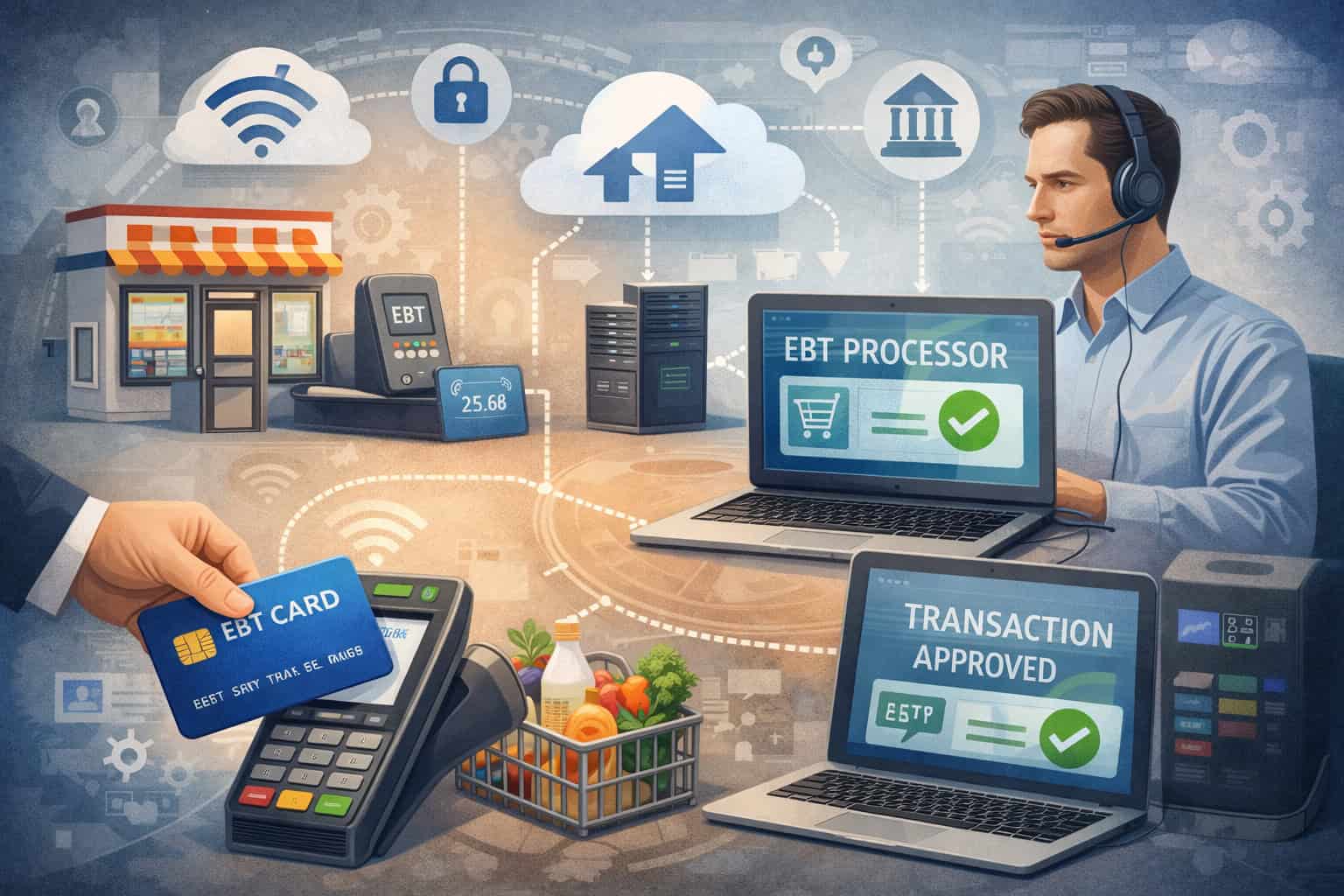
A Third-Party Processor for EBT is a specialized payments provider that helps a retailer accept Electronic Benefits Transfer (EBT) transactions—either in-store through point-of-sale (POS) terminals or online through secure PIN entry and transaction routing.
In practical terms, a Third-Party Processor for EBT sits between the retailer’s checkout system and the EBT system that approves and settles benefit transactions.
The processor can supply or support EBT-capable equipment, manage connectivity and message formatting, route authorizations to the correct EBT host, and help with testing, certifications, security controls, and ongoing operations.
A Third-Party Processor for EBT matters because EBT is not “just another card.” EBT transactions have strict program rules, specialized technical messaging, and PIN security expectations that differ from typical credit and debit flows.
Regulations also explicitly recognize the role of third-party processors and require states to provide interface specs and certification standards so third-party processors can participate in the EBT ecosystem.
In recent years, the role of a Third-Party Processor for EBT has expanded beyond in-store acceptance. A major growth area is online EBT, where secure PIN entry must occur in an approved way.
In that context, a Third-Party Processor for EBT often provides the secure online PIN-entry solution and routes the transaction for approval while enabling settlement to the retailer.
Because many retailers—especially smaller merchants—need help finding compliant equipment and services, official guidance and datasets also highlight Third-Party Processors for EBT options and selection tips.
How a Third-Party Processor for EBT Works in the Real World
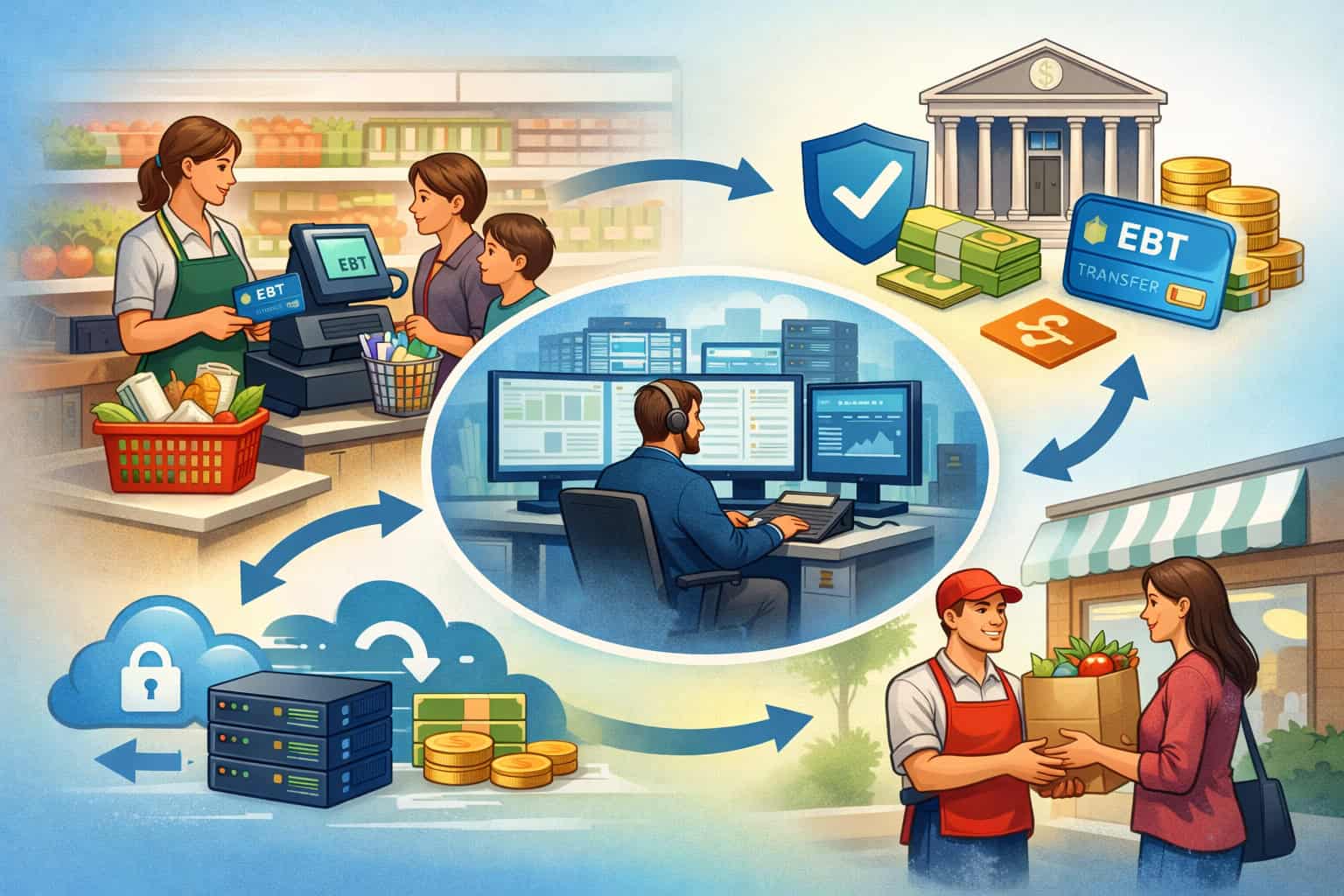
A Third-Party Processor for EBT typically plugs into your checkout flow in one of two ways:
1) In-store EBT acceptance (POS terminals)
Here, the Third-Party Processor for EBT may provide the terminal, maintain the connection path, and ensure the transaction messaging reaches the correct authorization endpoint. EBT systems must meet performance and security standards, and they rely on standardized message formats for retailers and third parties.
2) Online EBT acceptance (eCommerce checkout)
Online EBT requires secure PIN entry and encryption. A Third-Party Processor for EBT commonly supplies a compliant PIN entry method (often through an embedded component, redirect, or SDK-style flow) and routes the transaction for approval.
Retailer guidance for online participation repeatedly points out that retailers must select a Third-Party Processor (TPP) / PIN solution provider and integrate secure online PIN entry via the TPP’s API.
In both cases, the Third-Party Processor for EBT supports the behind-the-scenes tasks that make EBT acceptance stable and audit-ready: onboarding, testing, handling reversals, supporting balance inquiries (where applicable), maintaining logs, and coordinating with POS vendors or eCommerce platforms.
Under program rules, third-party processors also have defined responsibilities and liability expectations during transaction processing stages.
The simplest way to picture it: your POS or website collects the cart total and payment type, the shopper enters a PIN, and the Third-Party Processor for EBT helps securely move that request to the EBT host and return an approval or decline—without exposing the PIN or breaking program requirements.
Why Retailers Use a Third-Party Processor for EBT

Retailers use a Third-Party Processor for EBT to reduce risk, speed up activation, and avoid costly compliance mistakes.
EBT acceptance has operational details that can feel “invisible” until something goes wrong: mismatched configurations, failing encryption checks, incomplete certification testing, or checkout rules that accidentally allow non-eligible items to be paid with benefits.
A big driver is cost and responsibility. Official guidance emphasizes that SNAP-authorized retailers generally must arrange and pay for their own EBT equipment and services (with certain exceptions).
That means retailers must choose vendors thoughtfully and plan for hardware, software, monthly fees, and support—exactly the areas where a Third-Party Processor for EBT can help.
Another driver is omnichannel growth. Many merchants now need both in-store and online acceptance. Online participation has a formal process that starts with a Letter of Intent and continues through requirements validation, including the retailer’s choice of an online PIN solution/Third-Party Processor for EBT.
Finally, there’s the security driver. PIN-based transactions demand strong encryption and controlled handling. For online EBT, retailer technical Q&As note that retailers must contract and pay for PIN encryption services, and the choice of providers (including the Third-Party Processor for EBT) is up to the retailer.
A good Third-Party Processor for EBT doesn’t just “run transactions.” It gives retailers a practical path to accept EBT while keeping checkout reliable, secure, and aligned with program expectations.
Third-Party Processor for EBT vs. POS Provider vs. Merchant Acquirer
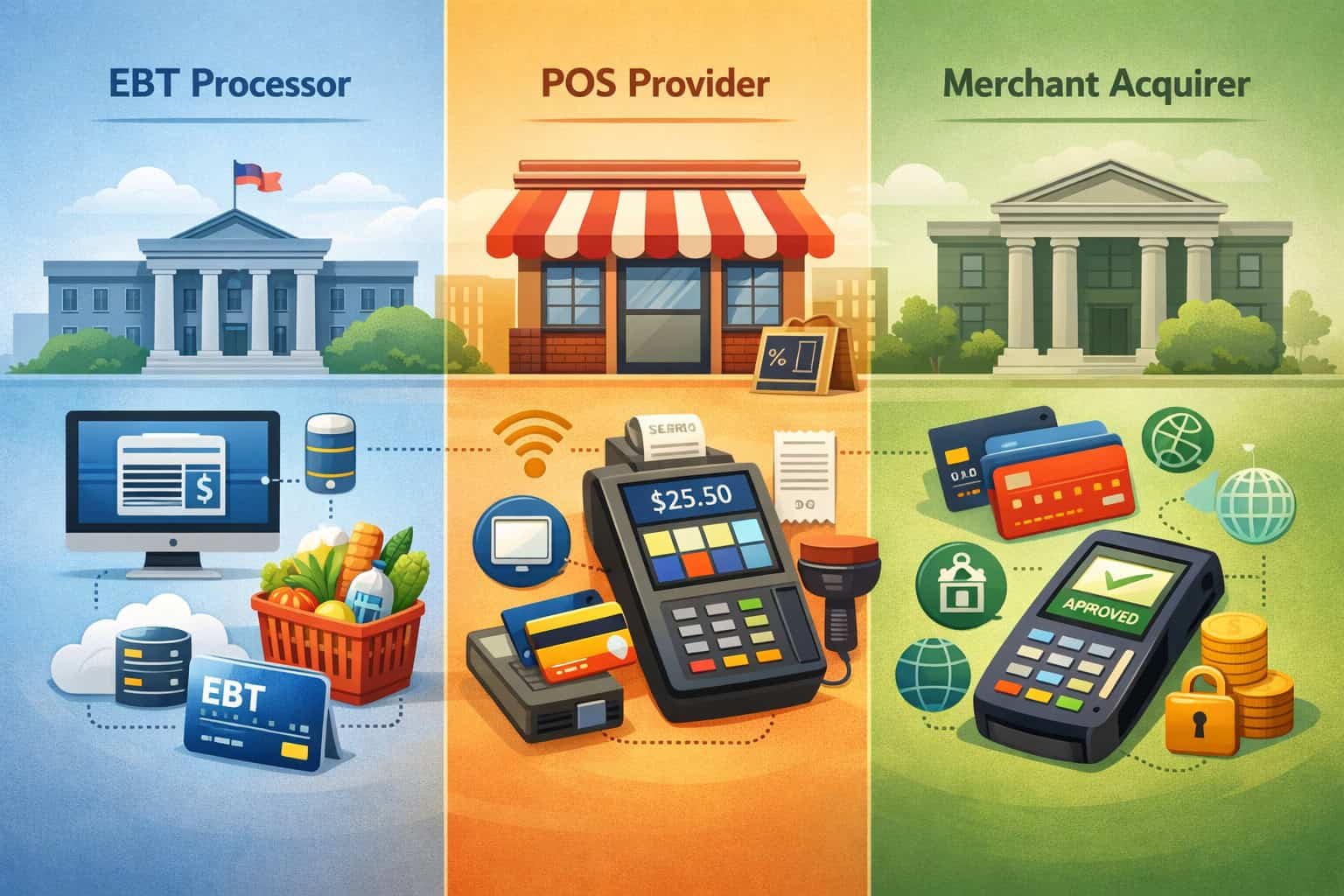
The payments stack can get confusing, especially when vendors bundle services. Here’s how to separate roles so you can choose the right Third-Party Processor for EBT.
Third-Party Processor for EBT
A Third-Party Processor for EBT focuses specifically on EBT acceptance and the technical routing, security, and certification requirements that come with it. In online EBT, the Third-Party Processor for EBT often provides the approved secure PIN-entry solution and routes transactions for approval by the issuer host.
POS Provider
A POS provider supplies the register software and sometimes the terminal hardware. Some POS platforms have built-in EBT support, while others rely on integration partners. Even when the POS claims EBT compatibility, you still may need a Third-Party Processor for EBT behind it to connect to the correct networks and complete testing and certifications.
Merchant Acquirer (for card payments)
An acquirer is typically involved in credit/debit acceptance. EBT is a separate ecosystem, but retailers often prefer a unified checkout device. Official selection guidance suggests that if you also accept credit/debit, it can make sense to choose a provider that supports EBT on the same terminal, depending on your business needs.
What a Third-Party Processor for EBT Provides
A Third-Party Processor for EBT can offer a mix of services. What you need depends on whether you’re accepting EBT in-store, online, or both.
EBT-capable equipment and terminal services
Many retailers start here. You may buy or lease terminals, and you’ll typically pay monthly service/processing fees. Guidance for choosing providers highlights practical factors: EBT-only vs full-service (EBT + card), lease vs purchase, and how easy it is to upgrade as requirements evolve.
Transaction routing and settlement support
A Third-Party Processor for EBT routes authorization requests to the correct EBT host and helps coordinate settlement outcomes so funds reach the retailer. In the online program context, industry references describe TPPs as routing transactions for approval by the issuer and managing settlement to retailers.
Certification testing and onboarding
Rules and guidance recognize that third-party processors undergo testing and must meet certification standards provided by state agencies. That process protects the system from unreliable or insecure integrations.
Security controls for PIN entry and encryption
Online EBT lives or dies on PIN security. Retailer technical guidance emphasizes that retailers must contract for PIN encryption services, and their choice of providers—including the Third-Party Processor for EBT—is the retailer’s decision.
Many providers align their security models with established encryption practices and documentation expectations (for example, point-to-point encryption solution frameworks used in broader payment security).
Ongoing operations and support
This includes monitoring, troubleshooting declines, reconciling batches, supporting reversals, and helping you stay compatible as chip cards and other upgrades expand.
For example, retailer materials about EBT chip card implementation note that merchants may work through their POS provider, acquirer, or Third-Party Processor for EBT to obtain test cards and scripts.
Third-Party Processor for EBT in Online EBT Acceptance
A Third-Party Processor for EBT becomes especially critical when a retailer wants to accept EBT on a website or mobile app. In online checkout, you must handle card data and PIN entry in a way that meets program and security requirements.
Retailer criteria for online participation explains that retailers must submit a Letter of Intent, then work through an approval process that includes meeting online requirements and selecting an online PIN solution provider/Third-Party Processor for EBT.
Additional materials describing the application process state that the retailer’s website must be capable of integrating secure online PIN entry via the Third-Party Processor for EBT API, along with error handling and user messaging.
Operationally, the Third-Party Processor for EBT often provides:
- A secure PIN capture method designed for online use
- Encryption and protected transmission
- A transaction routing layer to the EBT host
- Response handling so the shopper sees approve/decline clearly
- Support for edge cases like partial approvals and tender splits (where supported)
Retailer technical Q&As stress that the retailer chooses its providers and must contract for PIN encryption services as part of online participation.
This is why the Third-Party Processor for EBT is not just a “checkbox” vendor in eCommerce. It directly impacts conversion rate, shopper trust, and compliance posture. A weak flow increases abandoned carts; a noncompliant flow increases the risk of failing approval requirements or facing disruptions later.
Compliance, Liability, and Security Expectations
A Third-Party Processor for EBT operates inside a rules-heavy environment. Even if you outsource the technical work, the retailer still needs to understand what “good” looks like so you can evaluate vendors.
From a regulatory angle, program rules state that state agencies must allow retailers the opportunity to use third party processors and provide interface specs and certification standards.
They also state that third party processors undergo tests specified by the state and describe liability for transactions until electronic acceptance by contracted vendors or intermediate facilities (depending on the processing stage).
Separately, functional and technical requirements emphasize standards for processing speed, availability, reliability, and security, including references to standardized message formats used by retailers and third parties.
Security is the non-negotiable piece. EBT transactions are PIN-based, and online EBT requires secure PIN entry. Retailer technical guidance notes the retailer must contract for PIN encryption services and select their providers.
In broader payments security, point-to-point encryption frameworks and solution listings show how encryption environments and device handling are typically governed by formal instruction manuals and validated solutions—useful context when evaluating whether a Third-Party Processor for EBT treats encryption rigorously.
For retailers, the practical compliance mindset is simple:
- Choose a Third-Party Processor for EBT with a clear testing story
- Confirm how they handle PIN security and encryption responsibilities
- Ask what operational logs and reporting you’ll receive
- Make sure support and uptime commitments match your store hours and checkout volume
How to Choose the Right Third-Party Processor for EBT
Selecting a Third-Party Processor for EBT is a business decision as much as a technical one. The “best” choice depends on store count, transaction volume, omnichannel needs, and how much you want to bundle under one vendor.
Official selection guidance suggests starting with questions like:
- Do you want EBT-only services or full-service (EBT + other tenders)?
- Do you want to buy or lease equipment, considering upgrade paths?
- Are you also a WIC-authorized vendor (which may require additional coordination)?
Here are practical criteria that matter in day-to-day operations:
Integration fit
If you have an existing POS, confirm that the Third-Party Processor for EBT supports your specific terminal models and software version.
If you operate eCommerce, confirm the Third-Party Processor for EBT offers an integration pattern that fits your platform (custom site, hosted checkout, plugin, API/SDK approach). Retailer materials for online EBT specifically mention integration via the Third-Party Processor for EBT API.
Support quality and escalation path
EBT declines and connectivity issues can look like “a checkout bug,” “a network issue,” or “a configuration problem.” Make sure your Third-Party Processor for EBT offers real escalation—not just generic ticketing.
Pricing transparency
Ask for line-item pricing: equipment, monthly service, per-transaction fees, and any one-time certification/testing charges.
Security posture
For online EBT, ask exactly who is responsible for PIN encryption services and how the encryption approach is implemented and documented, aligning with the requirement that retailers contract for PIN encryption services.
Future readiness
With chip card implementation details being actively communicated to retailers—and testing guidance referencing your POS provider, acquirer, or Third-Party Processor for EBT—choose a vendor that can support upgrades, testing scripts, and device refresh cycles.
A reliable Third-Party Processor for EBT should be able to explain everything in plain language, including what you must do versus what they handle.
Implementation Roadmap for Retailers
A smooth rollout is more than “install a terminal.” Whether you’re implementing in-store EBT, online EBT, or both, a Third-Party Processor for EBT project should follow a structured path.
Step 1: Confirm your authorization and store setup
Before anything else, confirm your retail location and operations align with program participation requirements. Your Third-Party Processor for EBT may offer guidance, but you should treat authorization and compliance as your foundation.
Step 2: Choose your acceptance channels
Decide whether you need:
- In-store only
- Online only
- Omnichannel (both)
Online acceptance typically involves additional requirements and a formal participation process, including submitting a Letter of Intent and meeting published criteria.
Step 3: Select your Third-Party Processor for EBT and define responsibilities
Use provider selection guidance to decide EBT-only vs full-service and buy vs lease tradeoffs.
Document who is responsible for hardware, software updates, encryption, and customer support.
Step 4: Integration, testing, and certification
State agencies provide interface specs and certification standards, and third-party processors undergo testing as specified. For online EBT, integrate secure PIN entry via the Third-Party Processor for EBT API and implement required error handling.
Step 5: Go-live with monitoring and staff training
Train staff on tender selection, PIN retries, reversals, and receipts. EBT chip card guidance indicates that the shopper experience should remain broadly similar—select a tender type and enter a PIN—whether magnetic stripe or chip. After launch, monitor approvals, decline reasons, and peak-hour performance.
A Third-Party Processor for EBT should provide post-launch check-ins, because the first two weeks usually reveal configuration and operational gaps that weren’t visible in testing.
Common Challenges and How to Avoid Them
Even with a strong Third-Party Processor for EBT, retailers can run into predictable issues. The good news is that most of them are preventable with the right planning.
“We integrated online EBT, but checkout fails randomly”
This is often caused by incomplete error handling, timeouts, or edge cases like partial approvals. Retailer materials explicitly call out error handling and appropriate customer messaging as part of website readiness for online EBT.
Fix: test more scenarios, tighten timeouts, and improve shopper-facing messages so the customer knows what to do next.
“Our terminal works, but transactions are slow”
EBT systems have functional and technical standards for processing speeds, availability, and reliability.
Fix: confirm connectivity, ensure terminal firmware is current, and validate that your Third-Party Processor for EBT has adequate uptime commitments.
“We’re unsure who owns the problem—POS or processor”
This is common when vendors overlap.
Fix: define responsibility boundaries in writing. Your Third-Party Processor for EBT should provide a clear support matrix and escalation steps.
“Security requirements changed and now we need upgrades”
Selection guidance emphasizes that leasing can help with upgrades if technology or security requirements change.
Fix: plan refresh cycles and keep an upgrade budget. Ask your Third-Party Processor for EBT how they handle new requirements and testing.
“We want to expand to more stores”
Fix: choose a Third-Party Processor for EBT that supports multi-location rollouts with consistent configuration templates and centralized reporting.
When retailers treat a Third-Party Processor for EBT as a long-term partner—not a one-time vendor—these issues get smaller and less frequent.
Future Predictions: Where Third-Party Processor for EBT Is Headed
The next few years are likely to reshape what merchants expect from a Third-Party Processor for EBT. Some changes are already visible through active guidance and implementation materials.
Expansion of chip card readiness and testing
Retailer-facing chip card implementation details emphasize continuity of the shopper flow, and they point retailers to work with their POS provider, acquirer, or Third-Party Processor for EBT for test cards and formal scripts.
Prediction: more merchants will demand processors that can manage testing at scale and support mixed environments (stripe + chip during transition windows).
Stronger online EBT experiences
Online EBT participation guidance keeps highlighting secure PIN entry and the retailer’s selection of a Third-Party Processor for EBT / PIN solution provider.
Prediction: Third-Party Processor for EBT providers will compete on checkout UX—faster PIN flows, fewer redirects, better mobile support, and clearer decline messaging.
Increased security standardization
Retailers already must contract for PIN encryption services for online EBT, and encryption governance is moving toward clearer documentation and validated approaches.
Prediction: audits and security expectations will become more formalized, with stronger “prove it” requirements around encryption, key management, and operational controls.
More platform partnerships
As eCommerce platforms and POS ecosystems consolidate, Third-Party Processors for EBT vendors will increasingly ship plug-and-play integrations.
Prediction: marketplaces and ISVs will prefer a smaller set of certified Third-Party Processor for EBT partners, reducing “one-off” builds but raising the bar for vendors who want to be listed.
Data-driven operations
Prediction: merchants will demand better dashboards—approval rates, decline reasons, settlement timing, and outage alerts—so EBT acceptance becomes as measurable as card payments.
If you choose a Third-Party Processor for EBT today, pick one that is visibly investing in online EBT, chip readiness, and security modernization.
FAQs
Q.1: What is the main job of a Third-Party Processor for EBT?
Answer: The main job of a Third-Party Processor for EBT is to enable a retailer to accept EBT payments by providing the connectivity, routing, security, and support needed for approvals and settlement. In online EBT, the Third-Party Processor for EBT often provides the secure PIN-entry solution and routes transactions for approval.
Q.2: Do retailers have to pay for EBT equipment and services?
Answer: In general, official guidance indicates SNAP-authorized retailers must arrange and pay for their own EBT equipment and services (with certain exceptions). That’s why choosing a cost-effective Third-Party Processor for EBT and pricing model is important.
Q.3: Is a Third-Party Processor for EBT required for online EBT?
Answer: Online EBT requires secure PIN entry, and the online participation process and criteria emphasize selecting a Third-Party Processor (TPP) / online PIN solution provider and integrating secure PIN entry via the provider.
Practically, most retailers will use a Third-Party Processor for EBT for online acceptance because building compliant PIN entry alone is not realistic.
Q.4: Who decides which Third-Party Processor for EBT a retailer uses?
Answer: Retailer technical guidance indicates the choice of providers—including the Third-Party Processor for EBT—is up to the retailer, and retailers must contract for PIN encryption services as part of online participation.
Q.5: What should I ask before signing with a Third-Party Processor for EBT?
Answer: Ask about:
- Supported terminals and POS integrations
- Online EBT integration method (API/SDK/hosted)
- Testing and certification process
- PIN encryption responsibilities and documentation
- Pricing (equipment, monthly fees, transaction fees)
- Support hours and escalation
- Upgrade readiness for chip card changes and future requirements
Q.6: How does the approval process for online EBT start?
Answer: Retailers typically begin by submitting a Letter of Intent and then working through published requirements for online participation. A Third-Party Processor for EBT selection is commonly part of that readiness work.
Conclusion
A Third-Party Processor for EBT is the bridge that allows retailers to accept EBT transactions reliably and securely—whether at a physical checkout lane or inside an online cart.
The best Third-Party Processor for EBT does more than connect a terminal: it supports testing and certification, strengthens PIN security, improves uptime, simplifies troubleshooting, and helps your business stay ready as online EBT expands and chip-based changes continue to roll out.
If you’re choosing a Third-Party Processor for EBT, focus on fit and future readiness. Make sure the provider can support your POS environment, your online platform (if applicable), and your operational realities like weekend hours and multi-store growth. Use published selection guidance to weigh EBT-only vs full-service options and buy vs lease decisions.
For online EBT, treat secure PIN entry and encryption responsibilities as core requirements—not afterthoughts—because retailer guidance makes clear that retailers must contract for PIN encryption services and choose their providers wisely.